
Last updated November 2, 2026
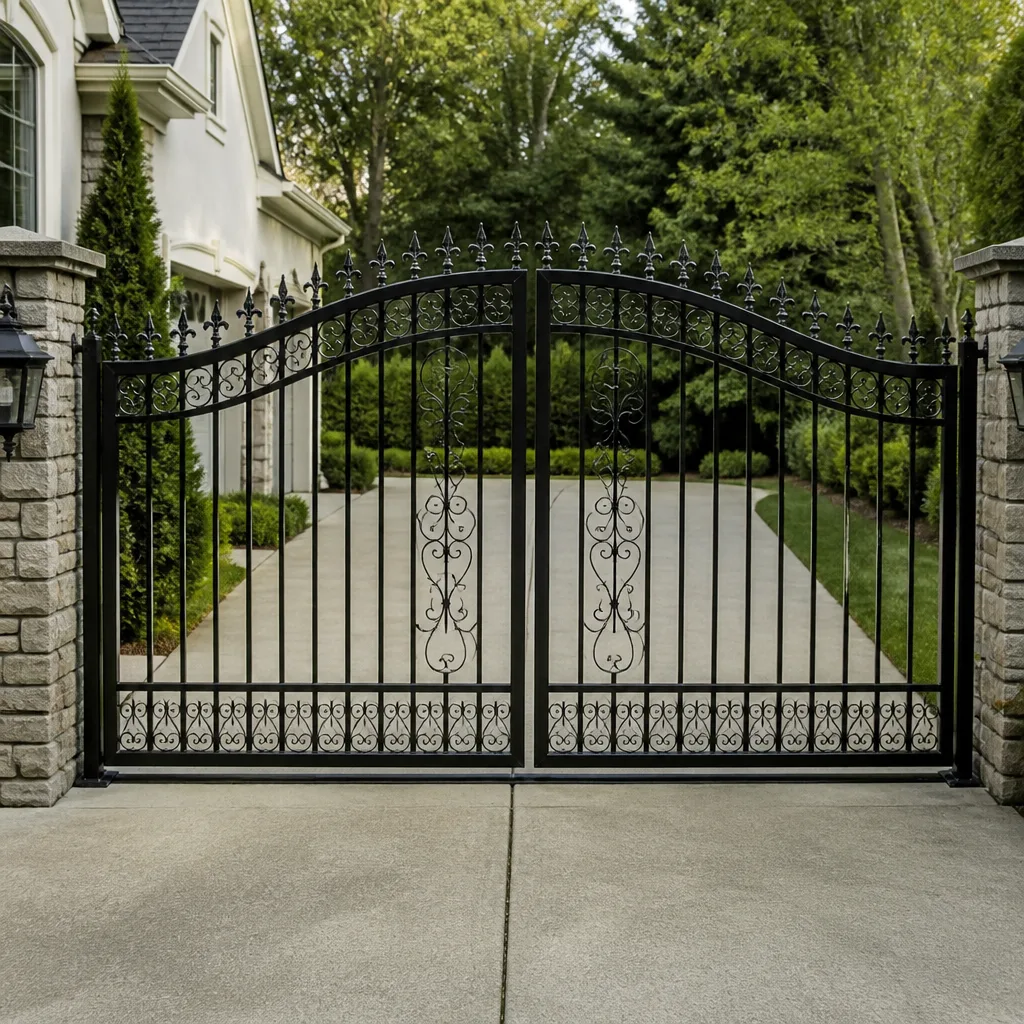 Wrought iron
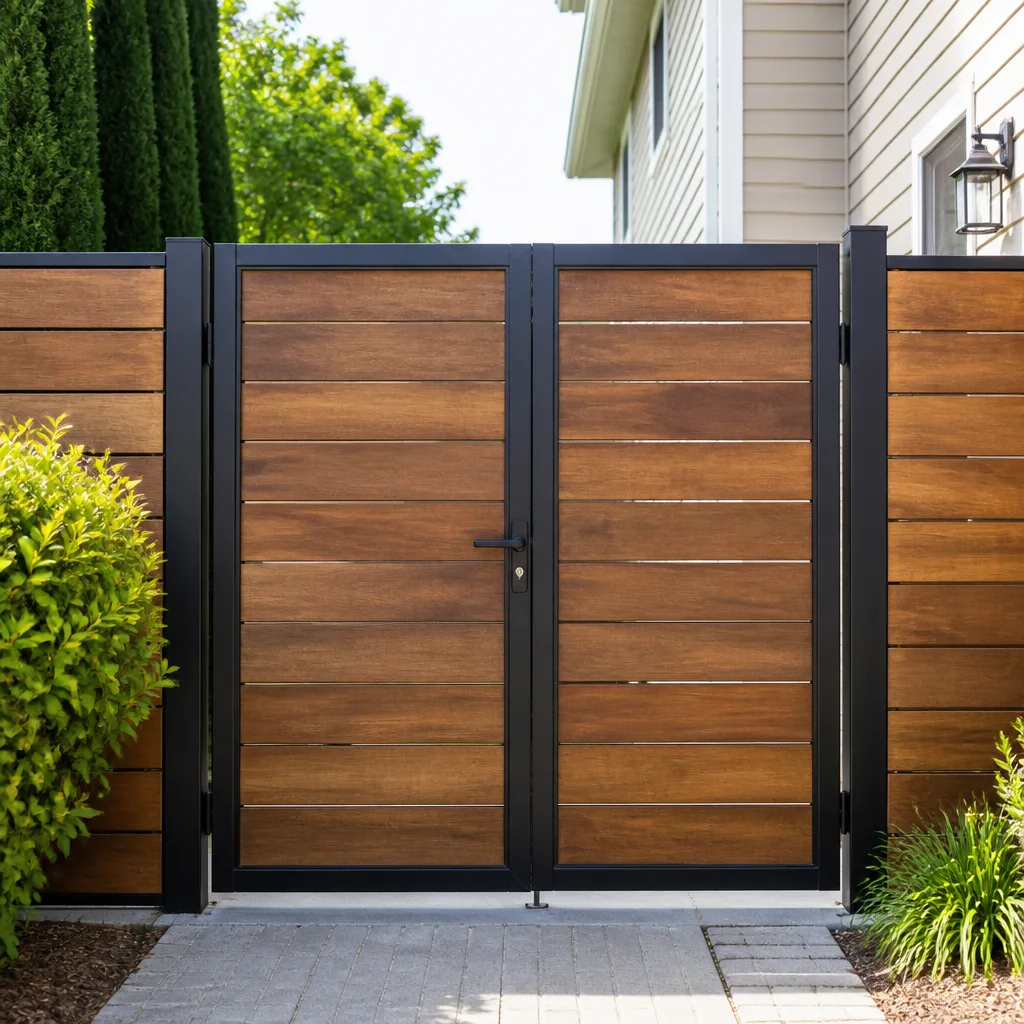 Wood & steel frame
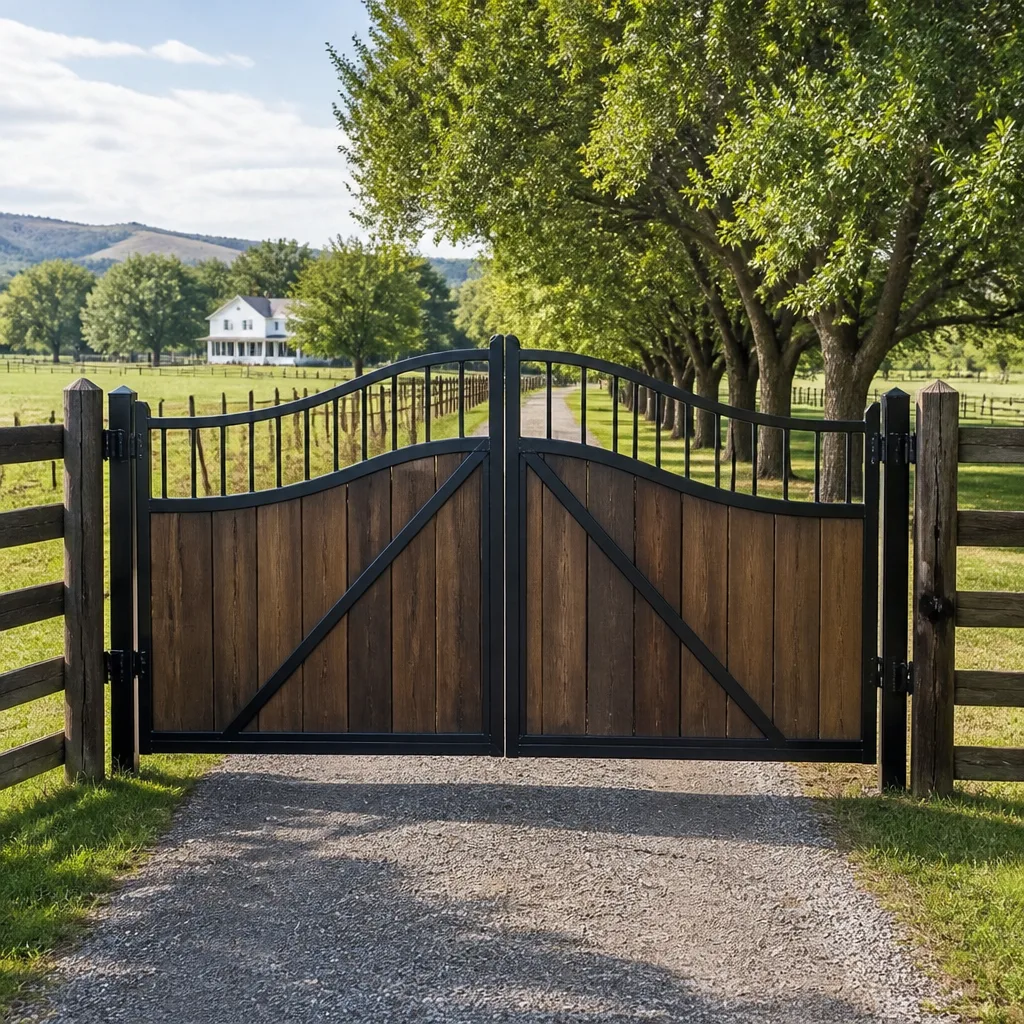 Farm & ranch
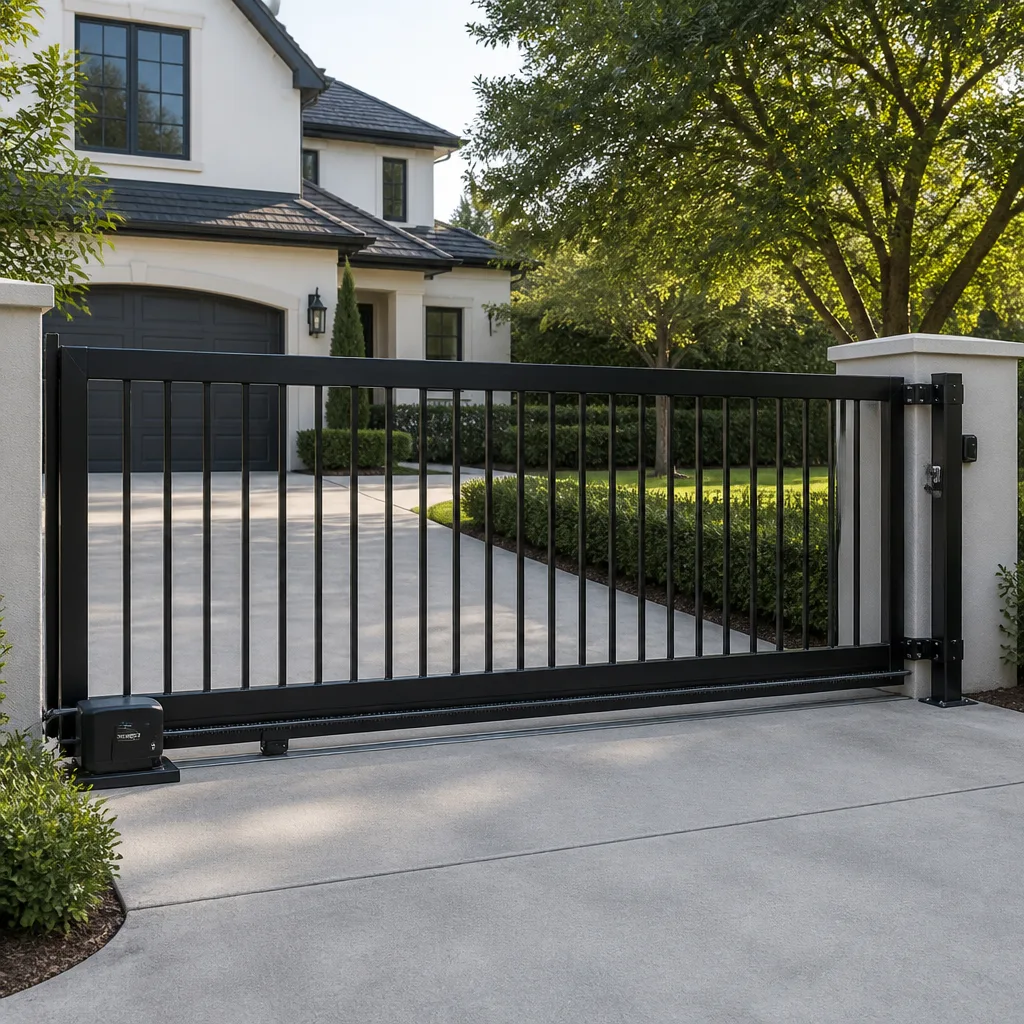 Sliding driveway gates
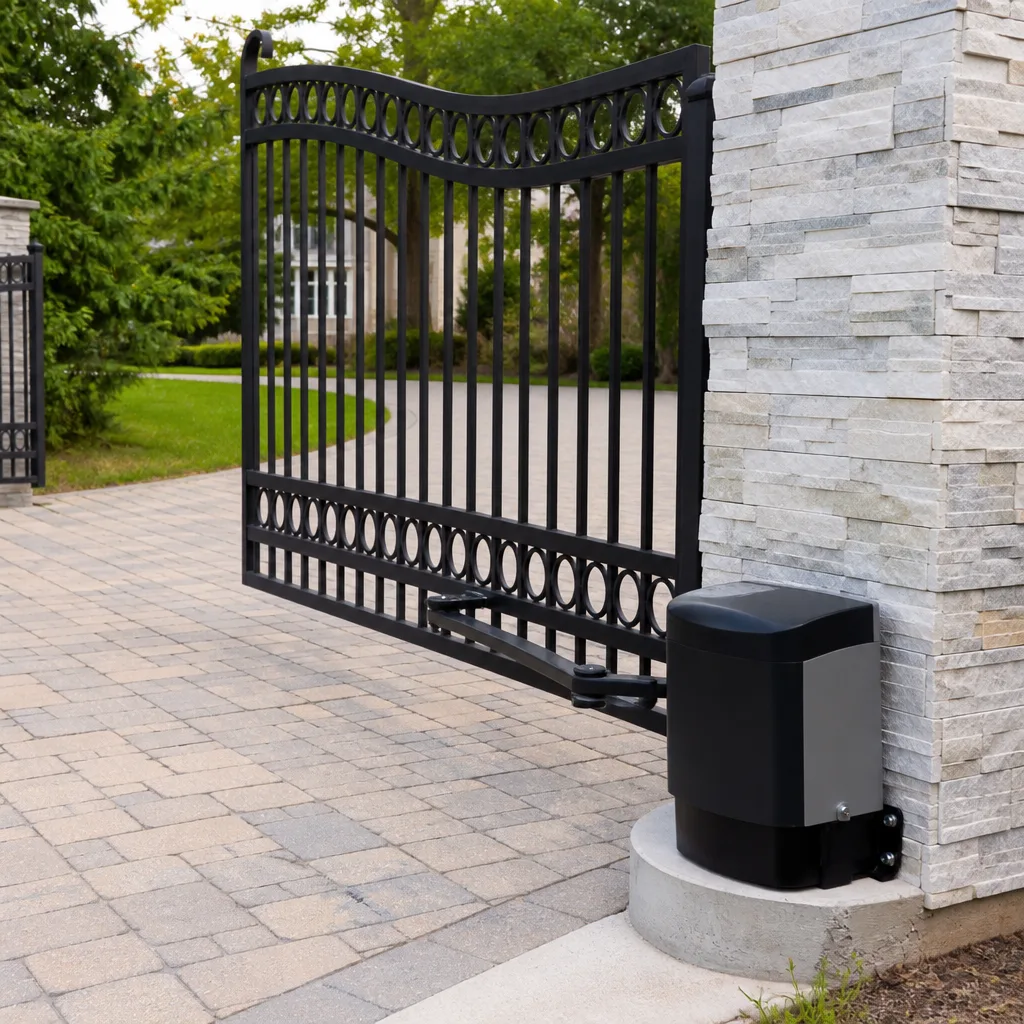 LiftMaster operators
Free on-site gate assessment - hinges, posts, and your LiftMaster or Nice gate operator checked before anything is quoted
The assessment is free and the quote is the invoice.
Get your free estimateGate Repair Emergency Preparedness Guide for Victorville Homes
Here’s a scenario most Victorville homeowners never consider until it’s too late: the power goes out during a summer thunderstorm or a rolling blackout, and your automatic gate becomes a locked barrier between your vehicle and the street. Most electric gate operators default to a fail-secure position when they lose power, which means the gate stays locked. The battery backup you installed, if you have one, gives you a handful of extra cycles before it dies too. This guide covers what actually happens when your gate loses power, how to manually disengage every major operator brand, what emergency responders need from gated properties in San Bernardino County, and how to build a household protocol that works when nothing else does. If you live along Bear Valley Road, in Spring Valley Lake, or up in the Mesa, this applies to you.
Quick Answer
Professional Gate Repair and emergency preparedness in Victorville means three things: knowing your operator’s manual release procedure, having a plan for when the gate is your only vehicle exit, and ensuring emergency access for fire and EMS through a Knox Box or equivalent system. During a power outage, most gates default to locked-closed, and the only way through without power is the manual release key. Every household with a gated property should create a simple gate emergency card and practice the release procedure at least once a year.
Styles & brands we work with
- Wrought iron
- Wood & steel frame
- Farm & ranch
- Sliding driveway gates
- LiftMaster operators
Table of Contents
- Manual Release Procedures by Operator Brand
- Battery Backup Sizing for Victorville Heat
- Fail-Safe vs. Fail-Secure: What Your Gate Does When Power Dies
- Emergency Access: Fire, EMS, and Knox Box Requirements
- Creating a Gate Emergency Card for Your Household
- Your 15-Minute Power Outage Protocol
- Warning Signs Your Gate Will Fail During the Next Outage
Manual Release Procedures by Operator Brand
The single most important skill for any gated property owner is disengaging the operator manually. Every electric gate has a mechanical release that lets you swing or slide the gate by hand when the motor has no power. The catch: each manufacturer hides it in a slightly different place, and if you haven’t practiced, you won’t find it in the dark with a flashlight app at 6 a.m. when you need to get to work.
We work on these systems daily across Victorville, Hesperia, and Apple Valley, and we see the same pattern over and over: homeowners who bought a house with a gate already installed and never learned where the release is. The previous owner didn’t leave the key. The installer didn’t explain it. The manual is long gone. Then the power fails and the gate becomes a wall.
Here’s what the release looks like on the most common operator brands we service:
LiftMaster and Elite Operators
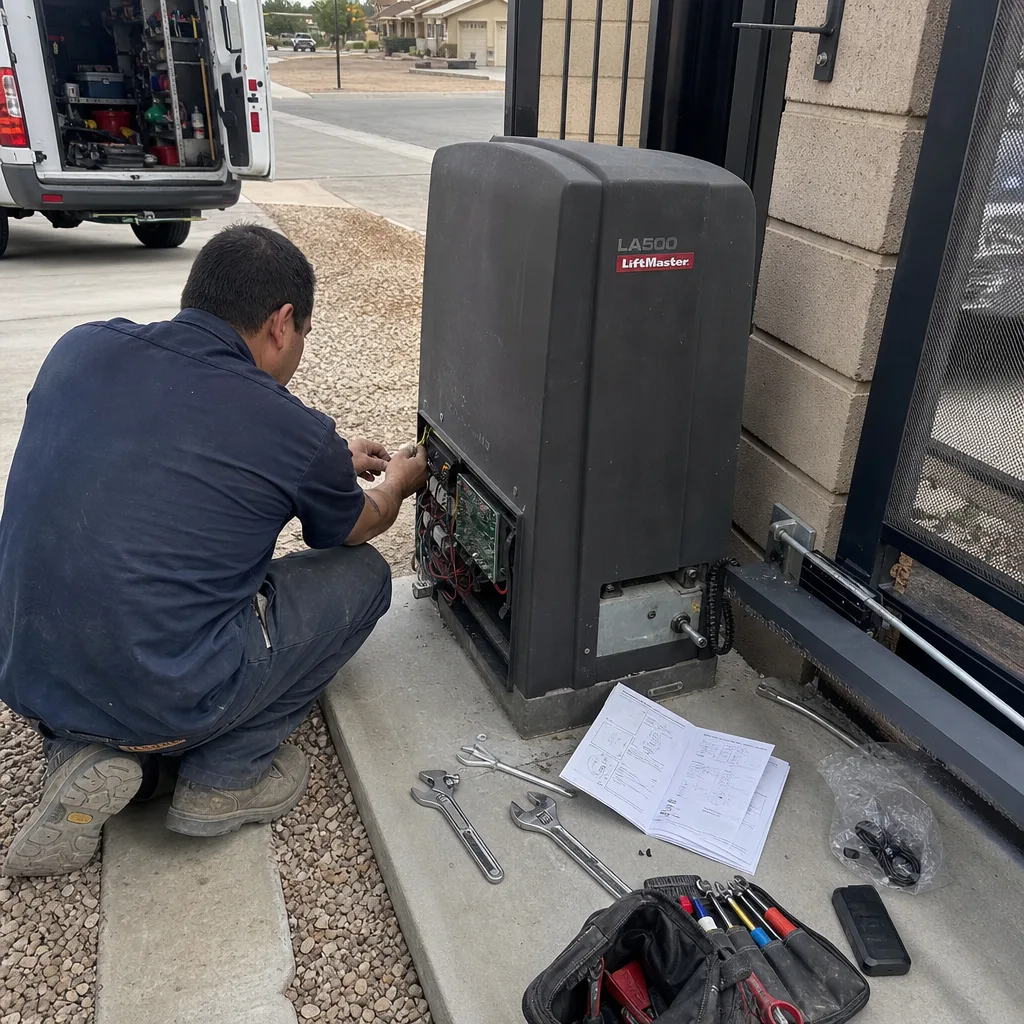
LiftMaster slide and swing gate operators (the LA400, LA500, and the commercial SL series) use a keyed manual release cylinder mounted directly on the operator housing. You insert the metal key, turn it a quarter to half turn, and pull outward. This disengages the gearbox from the drive chain or arm. The gate then moves freely by hand. Elite operators, which are common on Victorville residential properties and are a brand we service regularly, use the same basic mechanism: a keyed release on the side of the housing. If you don’t have the key, you cannot disengage the gate without cutting power and manually removing the release pin, which is not something you want to attempt during an emergency.
- Locate the keyed release cylinder on the operator housing.
- Insert the release key and turn it clockwise until it stops.
- Pull the release handle or turn the cylinder outward to disengage the gearbox.
- Push or pull the gate manually along its track or swing arc.
- To re-engage, push the release back in and turn the key back to the locked position.
FAAC Operators
FAAC systems, which we see on higher-end Victorville residential properties and a lot of HOA and commercial entrances, use a different approach. The manual release on a FAAC swing operator is usually a lever located on the bottom or side of the operator arm. Some FAAC models require you to remove a protective cover first. The release lever mechanically uncouples the worm gear from the output shaft. No key is needed on most FAAC residential models, which is actually an advantage in an emergency, but it also means a determined intruder can disengage it if the operator is accessible. That’s why we recommend keeping residential operator housings locked and considering a lockable cover plate for FAAC units that don’t have one.
FAAC commercial and high-cycle models (the 770, 400, and similar) often have a keyed release similar to LiftMaster’s. If your Victorville property has a commercial FAAC operator, treat it the same as a LiftMaster: know where the key is and test it twice a year.
Mighty Mule and Other Residential DIY Operators
Mighty Mule, Ghost Controls, and similar residential-grade operators use a simple pull-pin or lever release. On Mighty Mule swing openers, the release is a small metal pin with a ring that pulls straight out of the operator arm, disconnecting the arm from the gate bracket. Ghost Controls uses a similar design. These are the easiest releases to operate, which is good, because these operators are also the most likely to fail during a power surge. The trade-off: the pull-pin design wears out faster than a gearbox-style release, and we frequently replace stripped or bent release pins on these units in Victorville’s heat.
One note that applies to every brand: do not force the gate manually if the operator is still engaged. You can strip the gearbox, bend the drive chain, or snap the release mechanism, turning a simple power outage into a full operator replacement. This is the most common self-inflicted gate injury we see. If the gate won’t move by hand after you’ve disengaged the release, check for a physical obstruction before applying more force.
Battery Backup Sizing for Victorville Heat
Most gate battery backup systems are sized using the manufacturer’s rated capacity at 77 degrees Fahrenheit. Victorville summers routinely hit 105 degrees and above, which is where lead-acid battery capacity falls off a cliff. A battery rated for 20 cycles at 77 degrees may deliver 8 to 10 cycles at 105 degrees. For a family that uses their gate 15 to 20 times a day, a battery backup that looks sufficient on paper won’t get them through a single day of outage.
We recommend the following rule of thumb for Victorville: size your battery backup at 1.5 times the manufacturer’s recommendation, and replace it every two to three years regardless of rated lifespan. Heat is the enemy. A battery that sits in a metal operator housing all summer is running at 120-plus degrees internally, and that degrades the lead plates and electrolyte much faster than any manufacturer’s spec sheet suggests.
Here’s what a realistic backup calculation looks like for a typical Victorville residential gate:
- Single-family swing gate, LiftMaster LA400, two cars: 8 to 12 cycles per day average. Manufacturer recommends a 7Ah battery. We recommend 12Ah minimum for Victorville’s climate.
- Single-family slide gate, Elite SL series, three cars: 12 to 18 cycles per day. Manufacturer recommends 12Ah. We recommend 18Ah or dual 12Ah batteries in parallel.
- HOA or commercial gate, FAAC or BFT operator, high cycle: 50-plus cycles per day. This requires a dedicated backup power supply with deep-cycle batteries, not the small internal batteries sold with residential kits. If your commercial gate in Victorville doesn’t have a separate battery enclosure, it probably doesn’t have adequate backup.
One more Victorville-specific point: brownouts are more damaging to gate control boards than full blackouts. When voltage drops and spikes repeatedly, the capacitors and relays on the control board take the hit. A quality surge protector on the operator’s AC supply is non-negotiable here. We replace control boards damaged by brownouts more often than any other single component failure in this area – see our Gate Repair Maintenance Checklist for Victorville Homeowners for prevention tips. If you’re on the same grid section as a large commercial user or a pumping station, a whole-operator surge protection device is cheap insurance.
Fail-Safe vs. Fail-Secure: What Your Gate Does When Power Dies
Every electric gate operator has a fail mode: what it does when power is cut. The two options are fail-safe (the gate opens or can be pushed open) and fail-secure (the gate stays locked). The default on almost all residential operators is fail-secure, because manufacturers assume you want your driveway secure during a blackout. That’s also why most Victorville homeowners discover they’re locked out only when the power is already out.
Whether you should switch to fail-safe depends on your property and what’s behind the gate. There’s a real tension here, and it’s one we talk through with every customer:
When Fail-Safe Makes Sense
- Your gate is the only vehicle exit from the property.
- You live in a high fire risk area, which includes much of the Victorville foothills and the areas backing up to open desert.
- Anyone in the household has a medical condition where ambulance access time matters.
- The gate protects only the driveway, and the home itself has adequate door and window security.
California’s fire code, and San Bernardino County’s enforcement of it, increasingly favors fail-safe configurations for residential gates in wildfire-prone areas; our guide to Gate Repair Permits, Codes & Inspections in CA: What You Need to Know covers this in detail. When a fire evacuation order is issued, every minute matters, and a gate that defaults to locked can trap a family. The CalFire and county fire marshal guidance points the same direction: if you can’t reliably open the gate during an outage, the gate is a hazard. We’re seeing more and more insurance carriers in this area ask about gate fail modes as part of wildfire risk assessments.
When Fail-Secure Makes Sense
- Your gate is the primary security barrier for the property and the home has no other perimeter security.
- The property is a commercial facility where a locked gate is a security requirement, such as a storage yard or industrial lot.
- You have reliable backup power, either battery or a generator, that keeps the gate operational through extended outages.
The practical answer for most Victorville homes is a hybrid approach: keep the gate fail-secure during normal operation, but install a battery backup large enough to survive a full day, and make sure every licensed driver in the household can operate the manual release. If you live in a high fire zone, have a serious conversation with your gate technician about converting to fail-safe or installing a firefighter override switch. That switch, often called a firefighter key switch, lets first responders open the gate even when the operator is dead. It’s a small add-on with outsized value in an emergency.
We configure fail modes on FAAC, BFT, Linear, and every other operator we service, and the settings are different on each. This is not something to guess at in the control board menu. A wrong setting change can leave your gate permanently locked or permanently open, both of which are worse than the problem you were trying to solve.
Emergency Access: Fire, EMS, and Knox Box Requirements
San Bernardino County fire departments and EMS providers need to get through a locked gate in seconds, not minutes. A gate that can’t be opened delays an ambulance by however long it takes to find a key, break the gate, or force entry another way. For a cardiac arrest or a structure fire, that delay is measured in outcomes, not convenience.
The standard solution in California is a Knox Box: a small locked box mounted near the gate that holds a key or a gate release key, with the box keyed to the fire department’s master key. San Bernardino County fire jurisdictions expect Knox Box or equivalent access on gated commercial properties, multi-family properties, and HOAs. For single-family residential gates, the requirement is less universal, but if your gate blocks vehicle access to the property and the home is set back from the road, we strongly recommend it.
What fire and EMS need from a gated property, beyond a Knox Box:
- Clear gate dimensions: the access gate for emergency vehicles needs to be at least 12 feet wide to accommodate a fire engine. If your gate is a 10-foot residential gate, fire apparatus may not fit, and they need to know that before they arrive.
- Y-turnaround or hammerhead: if the gate leads to a driveway with no room for a fire engine to turn around, that limits which apparatus can enter.
- Lockbox location: the Knox Box should be mounted within 6 feet of the gate, clearly visible, and not blocked by landscaping. Overgrown oleander and decorative rock piles defeat the purpose.
- Gate operator type and fail mode on file: commercial and HOA properties should have gate specs on file with the responding fire district. If the operator fails, they need to know whether it fails open or closed.
- Manual release training for on-site staff: for HOAs and commercial properties in Victorville, the property manager should know the manual release for the specific operator on the gate. We train property staff on this regularly.
If you’re not sure whether your Victorville property has a Knox Box or where it’s mounted, walk out to your gate today and look. If you don’t see one, call the fire district’s non-emergency line and ask about their requirements for gated properties in your area. The conversation takes five minutes and could be the most important prep you do this year.
Another point that matters specifically in the High Desert: dust and wind. Sand and grit get into gate tracks, keyholes, and release mechanisms. A Knox Box or key switch that hasn’t been operated in a year may be jammed with fine desert silt. Test it. We’ve watched firefighters struggle with silted-over key switches, and it’s a preventable problem with a quarterly cycle of the lock and a quick shot of dry lubricant.
Creating a Gate Emergency Card for Your Household
The best-written gate protocol is useless if the person standing at the gate during an emergency doesn’t know it. In most Victorville households, one person handles the gate: they installed it, they maintain it, they know where the release key is. When that person isn’t home, everyone else is locked out of the knowledge, not just the property.
Create a single laminated index card that stays in the kitchen drawer, the garage, and the glove box of every vehicle. Here’s what goes on it:
- Operator brand and model: write it down. If the operator is a LiftMaster LA400 or a Mighty Mule MM562, put the exact model number on the card. When you call for repair, the technician needs this.
- Manual release location and how to operate it: a three-step description specific to your operator. Draw a small diagram if it helps. “Turn key clockwise, pull cylinder, push gate by hand” is enough.
- Release key location: where the metal release key lives. If it’s on a hook in the garage, say so. If there are spare keys, list them. In our experience, the release key is the single most commonly lost gate-related item in any home.
- Battery backup status: whether the gate has battery backup, where the battery is, and when it was last replaced. If the gate is beeping during an outage, what does that mean? (Usually: low battery, limited cycles remaining.)
- Gate repair contact: the phone number of the company that services your gate. If the gate is jammed and can’t be manually released, someone needs to make that call while the other person works the problem. Our number is (833) 589-9763.
- Emergency service note: whether the responding fire district has a Knox Box key, and where the Knox Box is mounted.
We recommend making this card a family project. Walk everyone through the manual release once, then have each person do it themselves while you watch. It’s a 15-minute exercise that pays off the first time the power goes out and the gate is the only thing between you and the street.
Your 15-Minute Power Outage Protocol
When the power drops in Victorville, you shouldn’t be improvising. Here’s a step-by-step protocol to follow, in order:
- Assess what the gate is doing: did it stay closed? Did it open? Is it mid-cycle? If the gate is mid-cycle when power drops, it will stop where it is, which could leave a gap in your perimeter or block the driveway.
- Check the battery backup: if the operator has battery backup and it’s working, the gate will still cycle, usually with a shorter pause before the motor starts. Conserve cycles: don’t test it more than once. Every cycle drains the battery.
- Decide whether the gate needs to stay open or closed: if you’re sheltering in place, leave it closed and locked. If you’re preparing to evacuate or need vehicle access, manually release it now, while you have light and time, not later when you’re rushed.
- Manually release if needed: use the card you made. If you don’t have a card yet, this is your reminder to make one. The release key is usually on a hook in the garage or in the operator’s lock cylinder.
- Leave the gate open or closed intentionally: a manually released gate will not re-engage on its own when power comes back. If you leave it open, it stays open. If you push it closed, it may not latch. Know which you’re choosing and why.
- When power returns, re-engage carefully: turn the key back, push the release in, and let the operator re-engage. Cycle the gate once from the keypad or remote to confirm it’s working before you call it good.
One more thing that surprises homeowners: the gate openers and keypads may lose their programming during an extended outage, especially if the battery backup also dies. When the AC power returns, some operators revert to factory settings, which means your remotes and keypad codes no longer work. This is not a broken gate; it’s a memory wipe. You’ll need to reprogram or call someone to do it. It’s one of the more common post-outage calls we get in Victorville.
Warning Signs Your Gate Will Fail During the Next Outage
Gates rarely fail without warning. They telegraph their problems for weeks or months before the actual failure, and most people ignore the signs because the gate still opens and closes. Here’s what we tell Victorville homeowners to watch for, and what each sign means:
- Slower-than-usual operation when the gate is on AC power: the motor is working harder than it should. This points to a mechanical issue: worn rollers, a sagging gate, debris in the track, or a dying capacitor. It will get worse, and the added load will shorten the life of the motor.
- Beeping or error lights on the control board: most operators use beeps and LED codes to signal faults. That beep when you cycle the gate isn’t a feature, it’s a warning. A flashing LED on the board is a diagnostic code. Don’t ignore it.
- The gate stops mid-cycle or reverses for no visible reason: this is usually a safety sensor or loop detector issue. The gate thinks something is in the way. It will get more sensitive over time, and eventually refuse to close at all.
- The backup battery test button does nothing: most battery-equipped operators have a test function. If you press it and the gate doesn’t cycle, your battery is already dead or disconnected. Your backup is decorative at that point.
- Corrosion or white crust on battery terminals: Victorville’s dry air slows rust compared to coastal California, but battery terminal corrosion still happens. Bad connections mean the battery can’t deliver current when the grid drops.
- Remote range is shrinking: if you have to be 20 feet from the gate for the remote to work when you used to work it from 100 feet, the receiver antenna or the board is failing. This often precedes a full board failure.
None of these signs are an emergency on their own. But all of them, left unaddressed, turn into emergencies: a gate that won’t open when you need it, a board that fries during a brownout, or a motor that burns out right when the temperature hits 110. We fix these problems every week, often on gates that have been showing symptoms for months. The repair is almost always cheaper and faster when addressed before failure than after. For ongoing maintenance advice, explore our more guides & resources.
Common Mistakes to Avoid
- Not knowing where the manual release key is: the key that disengages your operator is the single most important item on your property during a power outage, and most homeowners don’t know where it is. Find it today, not during a blackout.
- Forcing a gate that’s still engaged: if the gate doesn’t move easily by hand after you’ve turned the release, the operator is still engaged. Forcing it strips gears and bends drive components. We see destroyed gearboxes from this exact mistake, and it’s an expensive repair that a little patience would have prevented.
- Testing the battery backup too many times during an outage: every cycle drains the battery. If you cycle the gate five times to show the neighbors it still works, you’ve used up the backup margin you might need later.
- Assuming fail-secure is always the right setting: in wildfire zones around Victorville, a gate that locks closed during an outage can trap a family during an evacuation. Talk to a professional about your specific property before deciding.
- Ignoring beeps, error lights, and slow movement: these are the gate’s way of asking for help. They will become a full failure at the worst possible time.
- Using the wrong release key: it sounds obvious, but many operators use similar-looking keys, and the wrong key can shear off in the lock cylinder. If the key doesn’t turn easily, stop and verify you have the right one.
- Not having a Knox Box when your gate blocks emergency vehicle access: for some Victorville properties, especially those with long driveways or setback homes, this is a life-safety issue, not a convenience.
See the difference
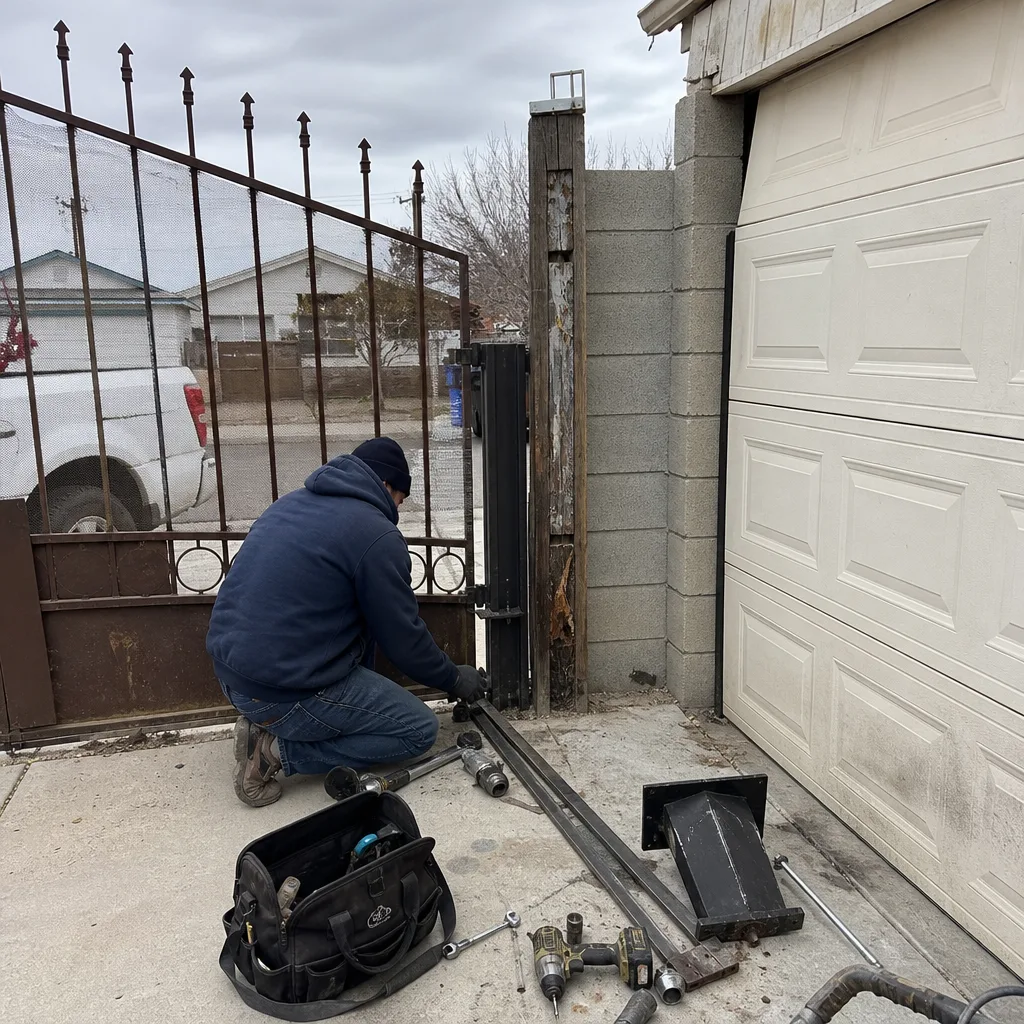 Before
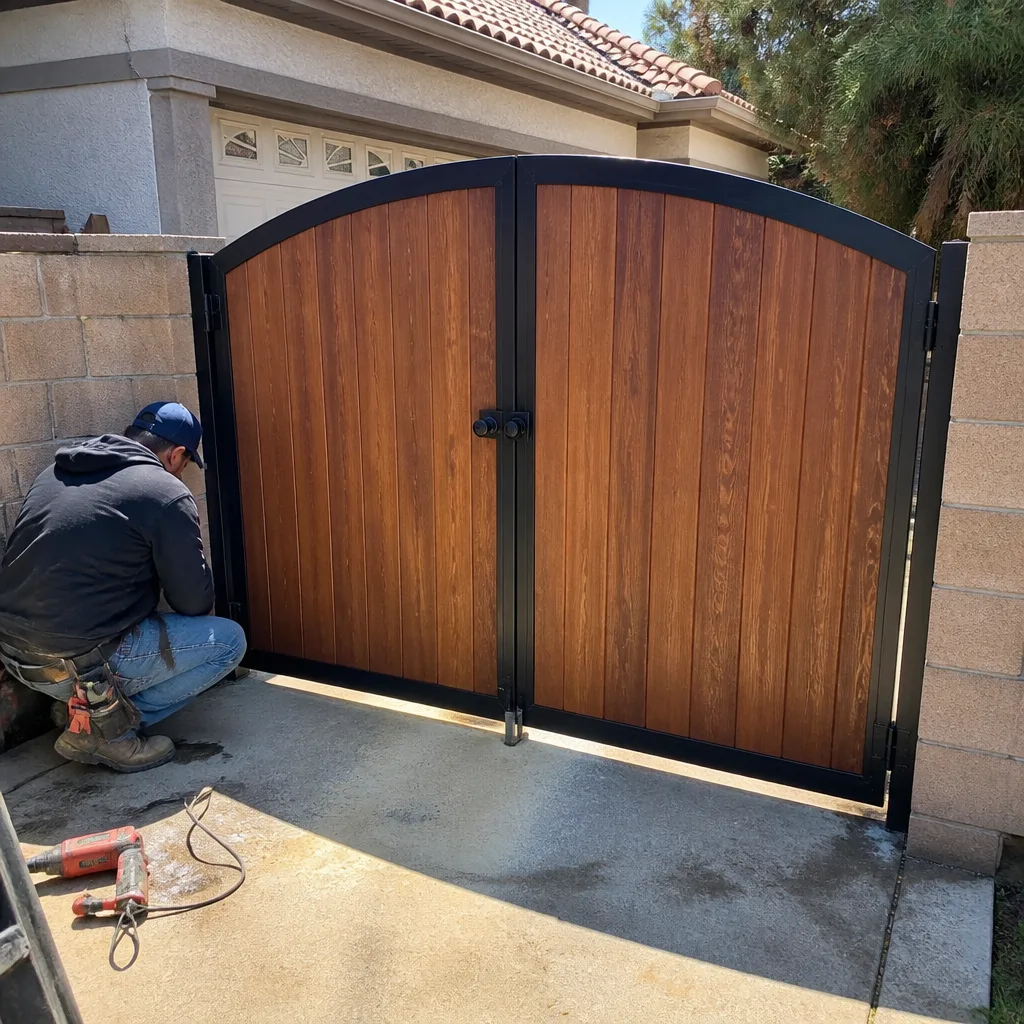 After
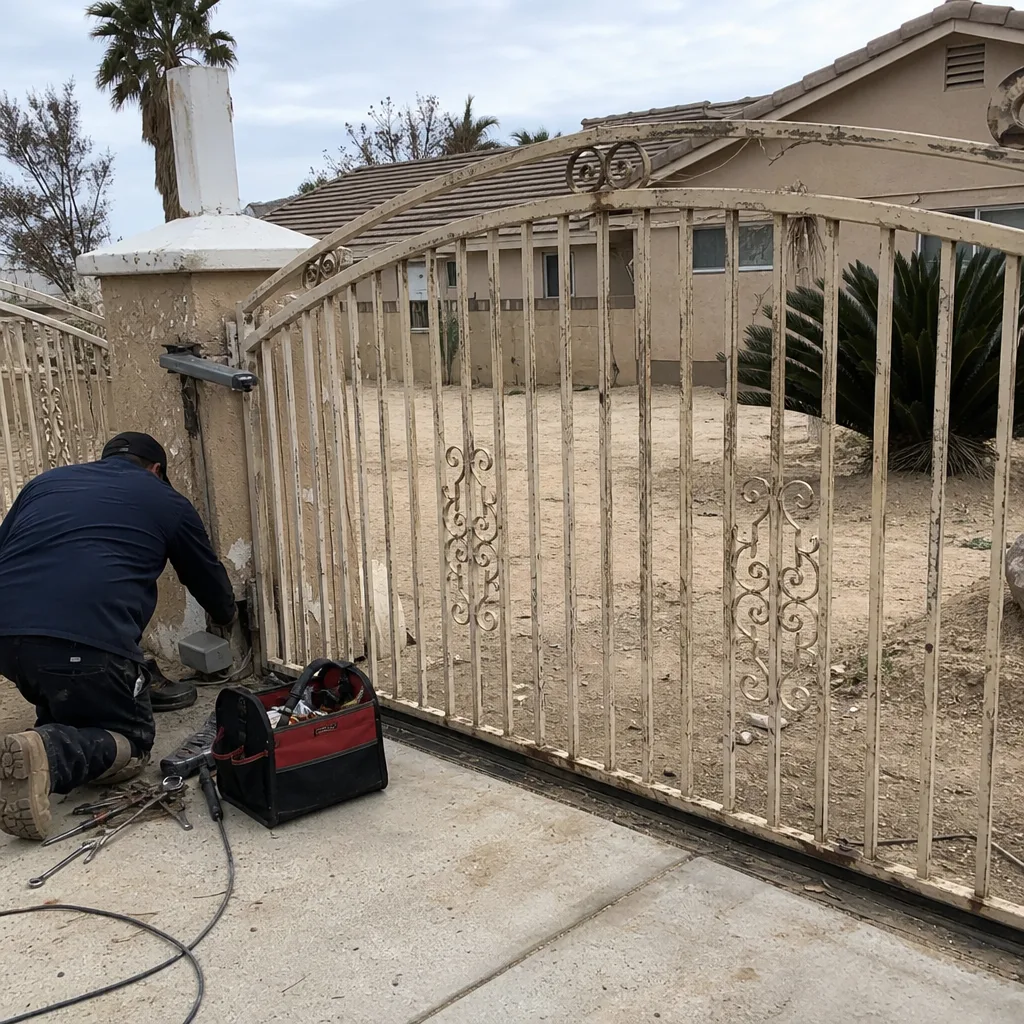 Before
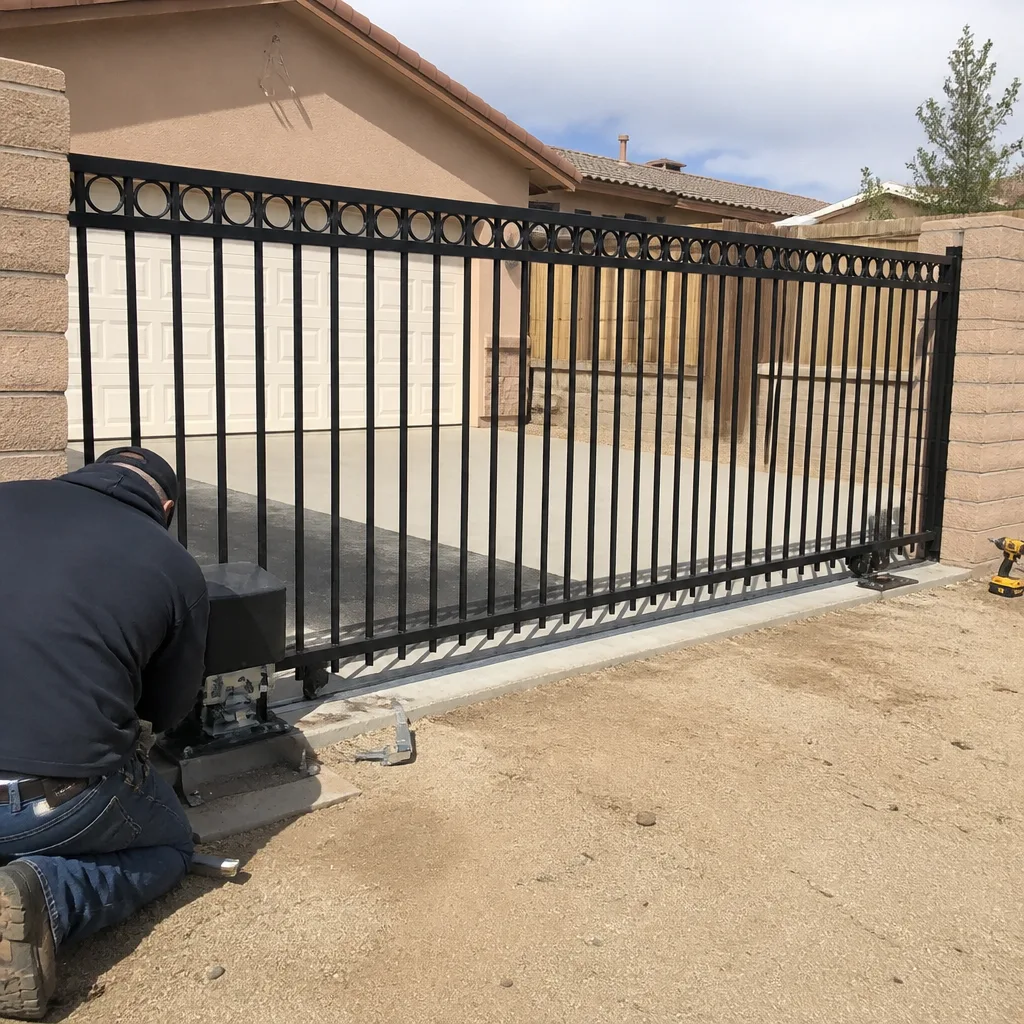 After
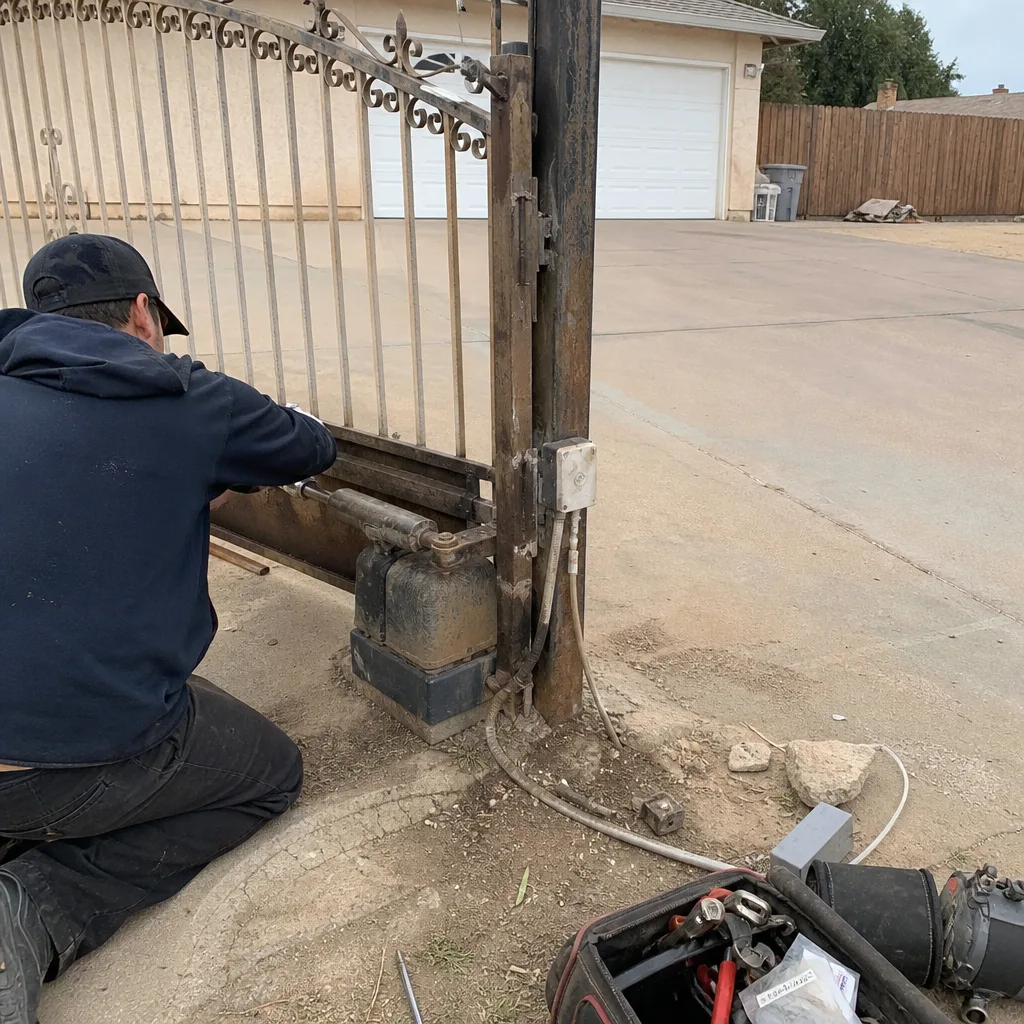 Before
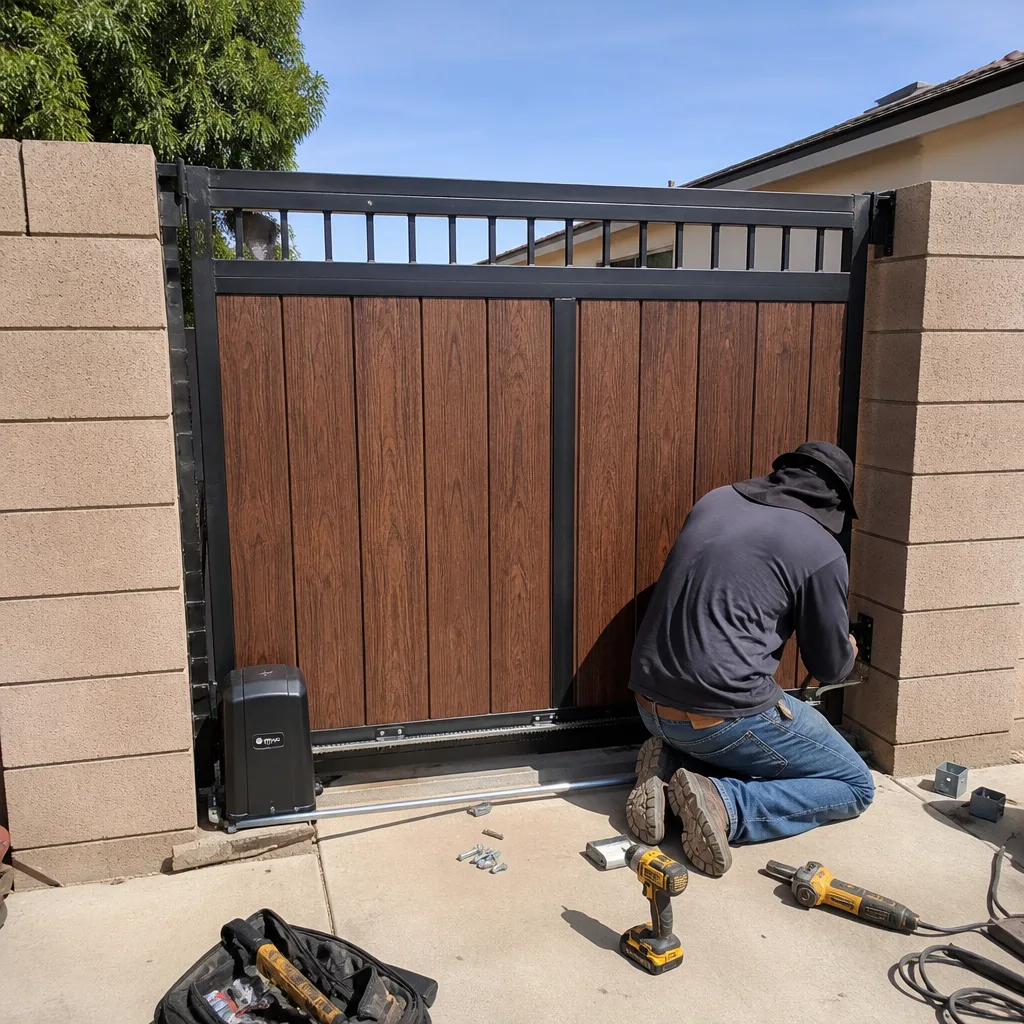 After
When to Call a Professional
Some gate problems are DIY-friendly, and some need a professional’s hands. If your gate won’t respond to the remote or keypad after power returns, the control board may have lost its programming and needs reprogramming or replacement. If the gate is physically jammed, bent, or the operator makes grinding noises, continuing to run it will destroy the motor. If you don’t have a manual release key, or the release mechanism is jammed, the gate is effectively locked and you need a technician with the right tools. If you’re configuring fail-safe versus fail-secure, installing a firefighter override, or wiring a battery backup, these are jobs where a mistake can leave your gate permanently inoperable or create a safety hazard. Gate Repair Victorville offers free estimates in Victorville, and we service every major operator brand including LiftMaster, FAAC, Elite, and Mighty Mule. Call (833) 589-9763 for a same-week appointment and a straight assessment of what’s actually wrong, not a sales pitch for a replacement.
Frequently Asked Questions
Yes, every electric gate has a manual release mechanism that disconnects the operator from the gate, allowing you to push or pull it by hand. The release is a keyed cylinder on LiftMaster and Elite operators, a lever on FAAC operators, and a pull-pin on Mighty Mule and Ghost Controls units. You’ll need the release key, so find it now and store it somewhere everyone in the household can access. If you don’t have the key, call us at (833) 589-9763 and we’ll help you identify what you need for your specific operator.
In Victorville’s summer heat, most residential gate battery backups last 8 to 12 cycles before dying, because high temperatures reduce lead-acid battery capacity significantly. That’s usually enough for a few hours of normal use, not a full day. If you need all-day backup, the battery needs to be oversized by at least 50 percent and replaced every two to three years. Call us at (833) 589-9763 for a specific recommendation based on your gate model and usage.
Fail-safe means the gate opens when it loses power, and fail-secure means it locks closed. Most residential operators default to fail-secure, which is why a power outage leaves so many Victorville homeowners locked behind their own gate. In wildfire zones, many fire departments recommend fail-safe or a firefighter override switch so first responders can always get through. The right setting for your property depends on your security needs and your fire risk, and it’s a simple adjustment for any operator we service.
Knox Box requirements in San Bernardino County depend on the property type and how the gate affects emergency access. Commercial properties, HOAs, and multi-family properties generally need a Knox Box or equivalent. For single-family homes, a Knox Box is strongly recommended if your gate blocks vehicle access to the home and the home is set back from the road, or if you live in a high fire risk area. Call your fire district’s non-emergency line to confirm what applies to your property.
Not necessarily. If the battery backup also dies during an extended outage, the control board may lose its programming and revert to factory settings, which wipes your remotes and keypad codes. The gate isn’t broken; it just needs reprogramming. We handle post-outage reprogramming and board replacement for all major brands. Call (833) 589-9763 and we’ll get you reconnected.
Listen for grinding, check for visible debris in the track or swing path, and run one full cycle while watching closely. If the gate moves smoothly and stops in the correct positions, it’s likely fine. If it’s slow, noisy, or stops mid-cycle, shut it off and have a professional inspect it before it fails. For a free quote in Victorville, call (833) 589-9763.
The Bottom Line
Your gate works right up until it doesn’t, and the moment it decides to fail is usually the moment you can least afford it. This guide gives you the three things that matter most: knowing your manual release by brand, having a realistic battery backup for Victorville’s heat, and ensuring emergency access for the people who need to reach you. Put the gate emergency card together, practice the release once a year, and watch for the warning signs. If you’re in Victorville, Hesperia, or Apple Valley and your gate needs attention before the next outage, we service every major operator brand and we’re happy to help. Call Gate Repair Victorville at (833) 589-9763 for a free estimate, or read more about gate repair in Hesperia, electric gate repair in Hesperia, and gate installation in Hesperia.
Written by the team at Gate Repair Victorville, serving Victorville since 2013.