
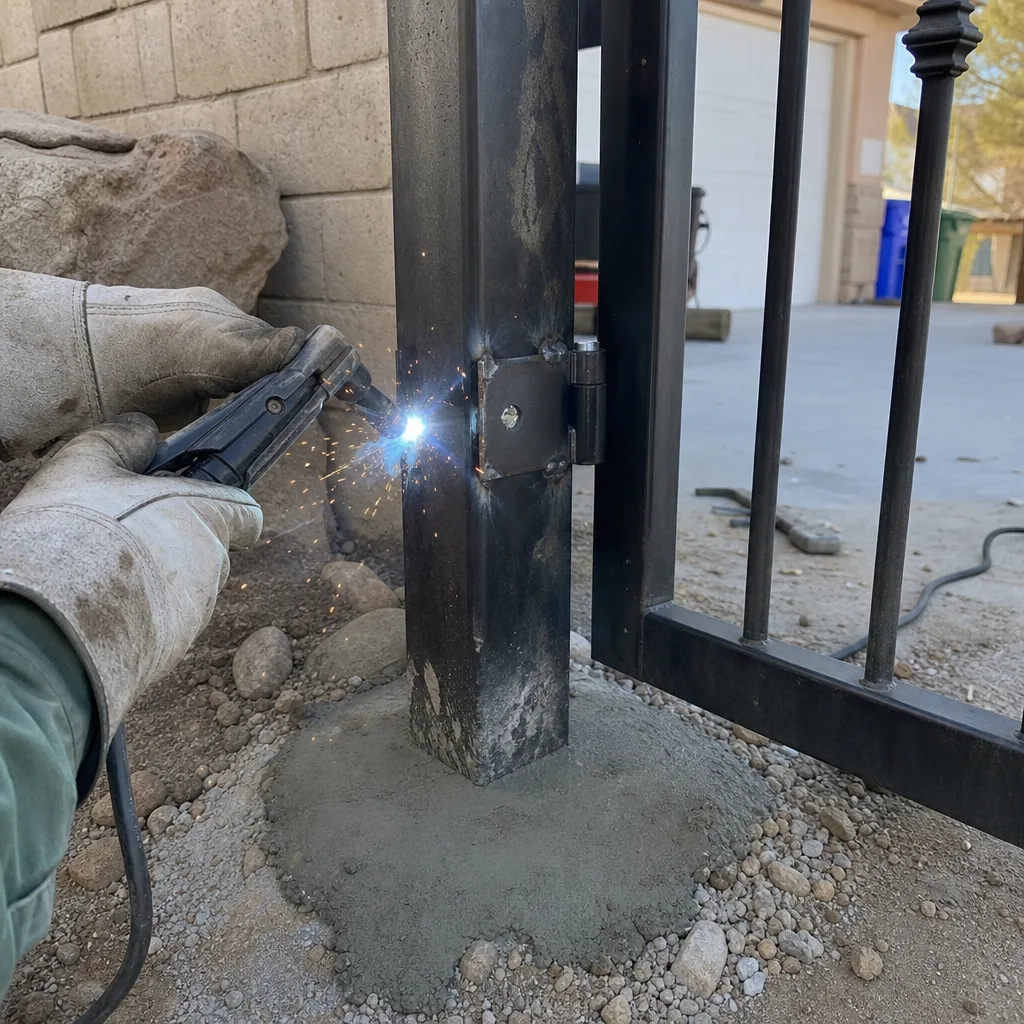
Last updated November 2, 2026
 Wrought iron
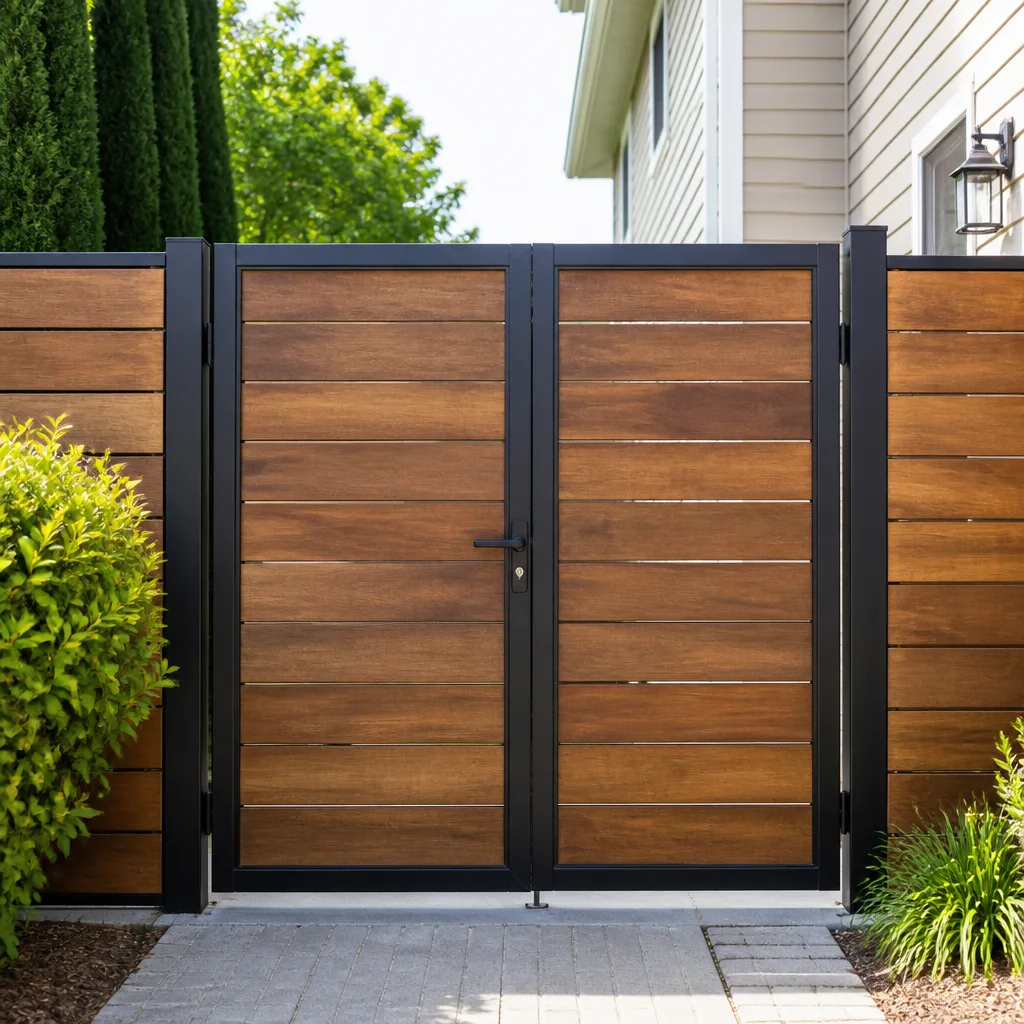 Wood & steel frame
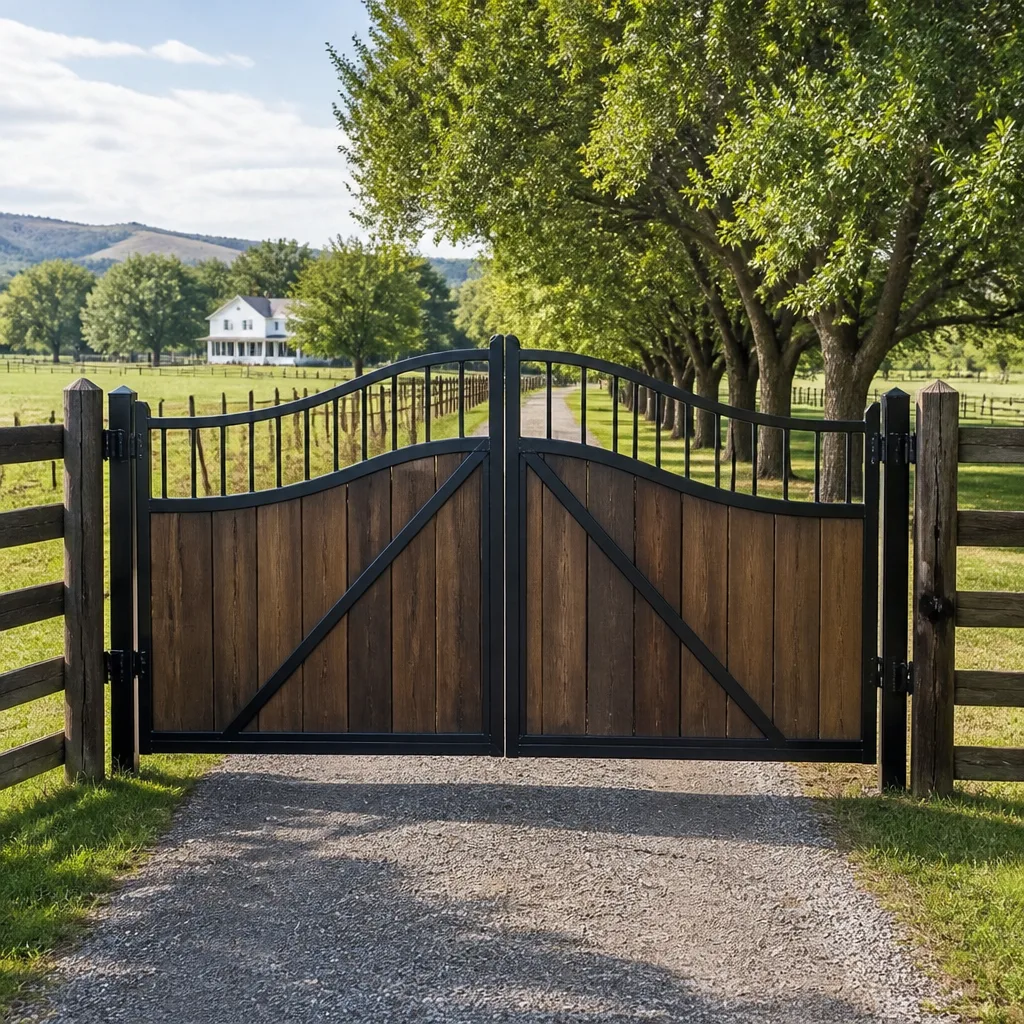 Farm & ranch
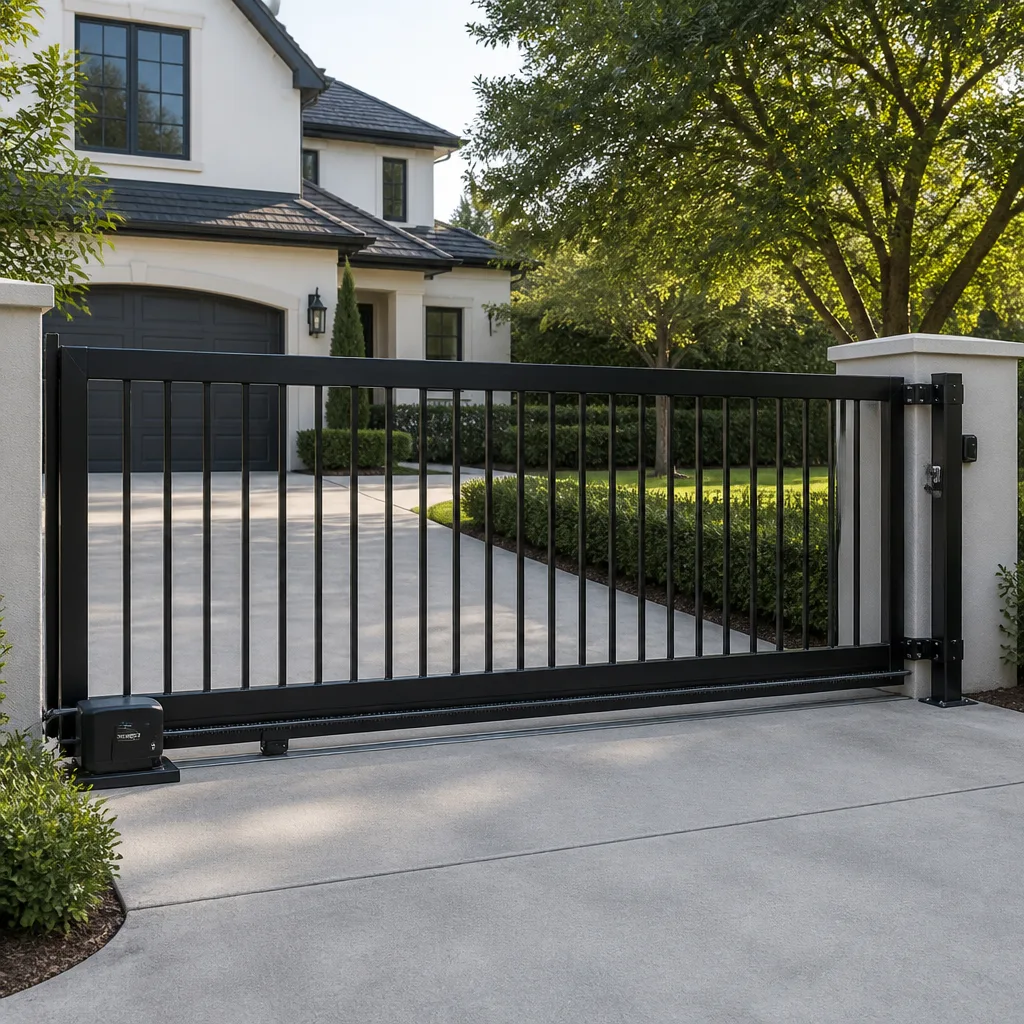 Sliding driveway gates
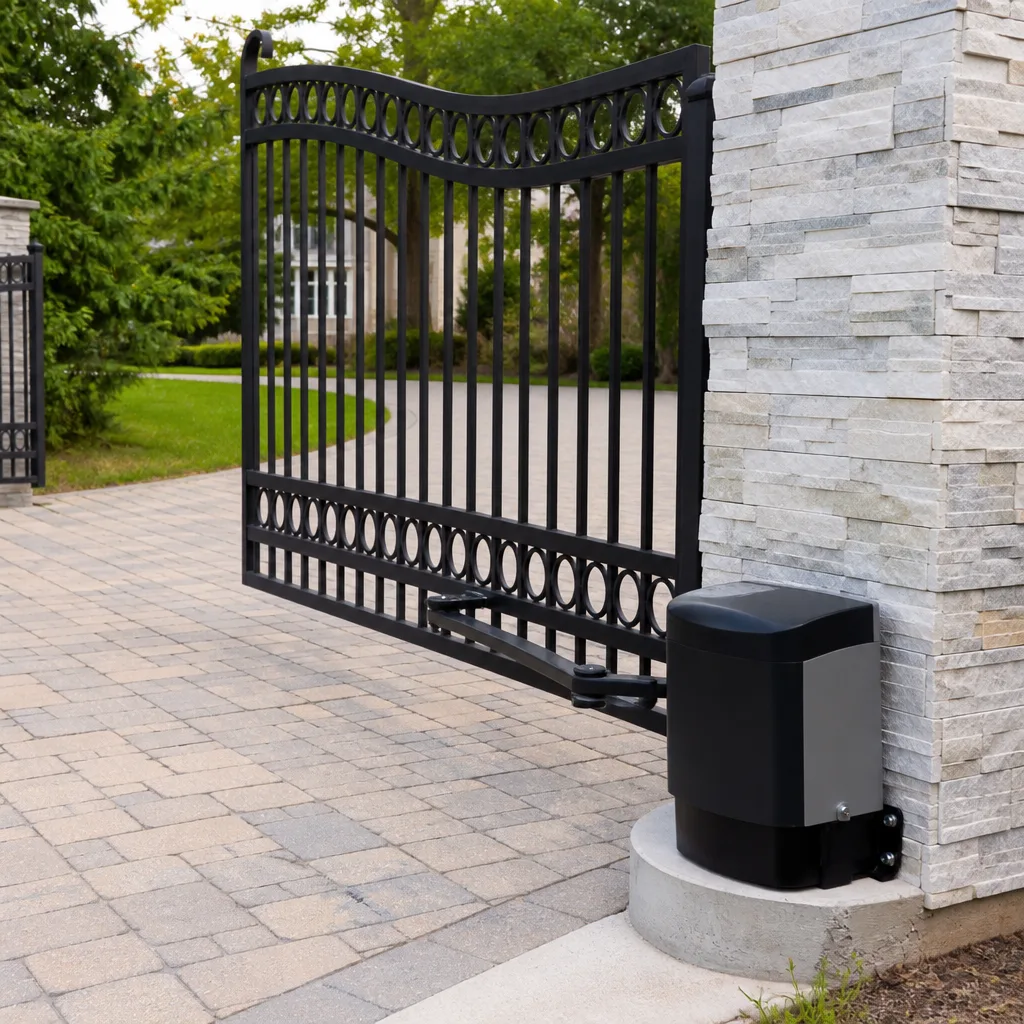 LiftMaster operators
Free on-site gate assessment - hinges, posts, and your LiftMaster or Nice gate operator checked before anything is quoted
The assessment is free and the quote is the invoice.
Get your free estimateGate Repair Maintenance Checklist for Victorville Homeowners
Lithium grease applied to a chain drive in Victorville’s summer heat turns into a grit-trapping paste within weeks. The wrong lubricant on the right schedule is worse than no maintenance at all. This guide is built for the specific conditions we deal with here: UV that bakes plastic components brittle, caliche dust that infiltrates every seal and bearing surface, and daily temperature swings of 40 degrees or more that loosen fasteners faster than coastal climates ever will. By the end, you’ll know exactly what to check, what to lubricate, what to leave alone, and when to call a specialist for our Gate Repair services.
Quick Answer
A proper gate maintenance checklist for Victorville homeowners covers six areas: lubrication with high-desert-appropriate products, fastener torque checks, foundation and post anchor inspection for caliche soil movement, battery backup testing, safety sensor and loop detector verification, and visual inspection of welds and frame joints for thermal fatigue. Most of this takes under 30 minutes every quarter, with one deeper inspection each year before summer hits. For Gate Repair Troubleshooting: Common Problems and How to Fix Them, see our detailed guide.
Styles & brands we work with
- Wrought iron
- Wood & steel frame
- Farm & ranch
- Sliding driveway gates
- LiftMaster operators
Table of Contents
- Lubrication: What Works in High-Desert Heat vs. What Doesn’t
- Fastener Torque Checks: Why Victorville Gates Loosen Faster
- Foundation and Anchor Point Inspection in Caliche Soil
- Battery Backup Testing: Desert Heat Degradation
- Safety Sensors and Loop Detectors
- Weld Points and Frame Joints: Thermal Cycling Stress
- A Seasonal Schedule That Actually Works
- What You Can Do vs. What Needs a Technician
Lubrication: What Works in High-Desert Heat vs. What Doesn’t
In Victorville, lubricant selection is not a preference question. It’s the difference between a gate that runs quietly for years and one that needs hinge or chain replacement by the next spring. Here’s what the heat does: a product that flows well at 70 degrees turns either to a dripping mess or a sticky film at 105. That film catches blowing caliche dust and sand, forming an abrasive compound that grinds metal against metal every cycle the gate runs. We’ve disassembled hinge pins from local gates where the “lubricated” surface looked like fine-grit sandpaper.
For hinge pins and pivot points on swing gates, the right product is a dry-film lubricant with PTFE, or a heavy-duty silicone paste rated for high temperatures. These stay in place without attracting dust. Apply sparingly. A thin even coat is enough. Wipe away any excess because whatever squeezes out will collect grit. For chain drives, use a chain-specific lubricant designed for open chains in dusty environments. These penetrate the links and leave less residue than lithium grease. The white lithium aerosol most hardware stores sell is exactly what we’re telling you to avoid on exposed components in Victorville conditions. For rollers and wheels on slide gates, a dry graphite or PTFE spray works better than wet grease, especially on the roller axles where dust loads are highest.
What to lubricate and what to leave dry:
- Hinge pins and pivot points: lubricate every 3 months with dry-film PTFE or high-temp silicone paste.
- Chain drives: apply chain-specific lubricant every 6 months, then wipe the chain with a clean rag to remove surface residue.
- Slide gate rollers and axles: dry graphite or PTFE spray every 3 months. Do not wet-lubricate wheels on the track surface itself.
- Track surface: keep clean and dry. Never lubricate the top of the track where wheels roll. A lubricated track causes wheel slip on high-cycle operators.
- Gate hinges on ornamental steel gates: inspect for rust erosion at the weld point before lubricating. If the hinge is grinding metal-on-metal, lubrication masks the problem; the hinge likely needs replacement.
If you’re not sure what product matches your gate’s hardware, a Gate Repair Victorville home inspection includes a full lubrication pass with products matched to each component. The products cost less than one hour of service time, and using the wrong one costs you hardware.
Fastener Torque Checks: Why Victorville Gates Loosen Faster
Every gate in the high desert goes through a daily cycle that works against its own bolts. Daytime heat expands steel and aluminum. Nighttime cold contracts it. Over hundreds of cycles per year, this thermal movement backs out nuts, bolts, and screws that were properly torqued at installation. We see it constantly on Victorville properties: gate operators that shake during operation because the mounting bolts worked loose over a single summer. The gate didn’t fail. The fasteners did.
Check these points quarterly with a hand tool. Do not use an impact driver for this. You want to feel whether a fastener moves before it’s fully seated. If a bolt turns freely before it’s snug, it was loose and needs proper torque. If it doesn’t move at all, it’s fine. Write down which fasteners were loose. If the same one loosens twice in a row, that’s a sign the threaded hole is wearing or the bolt is stretching. Replace the hardware rather than tightening it indefinitely.
- Operator mounting bolts: the four to six bolts holding the operator to its pad or post. Check with a socket, not a wrench on an angle.
- Hinge bolts and hinge plate screws: all fasteners connecting the gate leaf to the post, both the gate side and the post side.
- Wheel carriage and roller bracket bolts on slide gates. These carry the full gate weight and get hammered every cycle.
- Chain tension bracket bolts on chain-drive slide gates. A loose bracket throws chain alignment off and accelerates sprocket wear.
- Arm and link pin hardware on swing gate operators. These pins see cyclical loading and will loosen.
- Post caps and top rail fasteners where the gate frame joins decorative elements. Loose caps rattle and crack welds over time.
In our experience, gates in Victorville need fastener checks twice as often as gates in coastal cities. If you bought a home with an existing gate and don’t know when it was last serviced, assume every fastener is suspect until checked. The same goes for Gate Repair in Hesperia properties: the Hesperia lot soils and temperature swings put equivalent strain on hardware, and we see the same loosening pattern there.
Foundation and Anchor Point Inspection in Caliche Soil
Much of Victorville sits on caliche: a hard, cement-like calcium carbonate layer that sits a few inches to a few feet under the surface. It’s difficult to dig through, which is why gate posts often get set in concrete that’s shallower than it should be. Over time, a few things happen. The caliche itself can crack with moisture cycles, shifting slightly. The concrete collar around a post can separate from the surrounding caliche. And when wind loads hit a solid gate leaf, the post acts as a lever. A shallow-set post in fractured caliche will begin to lean. Slowly at first, then visibly.
Walk out to each gate post and look at the base. What you’re checking for:
- Gap between concrete and post: any visible cracking or separation at the post base, even hairline, means water is getting in and the post is moving.
- Soil color change around the post: if the dirt directly against the concrete is darker or lighter than the surrounding soil, water is pooling there. Caliche drains poorly, so water sits and works at the concrete bond.
- Gate leaf shift at the latch: if the gate catches or the latch used to line up and now doesn’t, the post is out of plumb even if it looks straight from the street.
- Cracks radiating from the post through the concrete slab or driveway near the gate. These are the tell of post movement under load.
Post movement is not a DIY fix. Shimming hinges or grinding the latch only buys time while the post continues to lean. Proper repair means excavating, resetting the post deeper, and recasting the collar, or adding a steel post insert with new concrete. It’s the kind of repair that looks simple and gets worse when treated as a weekend project. If your gate post is moving in Victorville’s caliche, get it evaluated before the gate leaf puts enough leverage on the hinges to crack them.
Battery Backup Testing: Desert Heat Degradation
If your gate operator has battery backup, whether it’s a solar-powered Mighty Mule on a rural Victorville property or an AC operator with a backup cell for power outages, heat is the primary killer of that battery. Most sealed lead-acid and AGM batteries are rated for service at 77 degrees. Every 15 degrees above that cuts service life roughly in half. A battery in a steel operator cabinet sitting in Victorville direct sun can easily reach 120 to 140 degrees inside. Your battery is aging at two to three times the rate the manufacturer expects.
Test battery backup quarterly. Here’s the protocol:
- Disconnect the operator’s AC power at the breaker or unplug the transformer, not at the battery terminals.
- Activate the gate with your remote or keypad. The gate should complete a full open and close cycle on battery alone.
- Time the cycle. A healthy battery runs the gate at near-normal speed. A weakening battery moves the gate slower, and cold weather slows it further.
- Run five full cycles if your gate is a high-use entry. If the gate completes all five at normal speed, the battery is holding capacity.
- Reconnect AC power and verify the operator reconnects automatically.
For solar-powered operators in Victorville, check the solar panel for dust accumulation. Caliche dust builds a film on the glass that cuts charging efficiency, and a solar panel that’s only delivering 60 percent of its rated output in December has a hard time topping off a battery that’s already heat-stressed. Panel voltage at midday should match at least 18 volts on most 12-volt systems under load. If it doesn’t, get a specialist to test the panel and battery as a pair. On Hesperia properties with Electric Gate Repair in Hesperia service, the same heat profile applies; the Hesperia side of the bench sees identical battery degradation.
Battery replacement is not brand-specific. Whether the system is a Viking or a BFT operator, the cell is a consumable part with a finite service life in this climate. Plan to replace backup batteries every two to three years in Victorville, not the five to seven years a coastal owner might get.
Safety Sensors and Loop Detectors
Safety sensors are the most important components on an automatic gate, and the most neglected. Victorville’s blowing dust coats photo-eye lenses within weeks. A sensor that still works in your driveway test can fail partly through a cycle because the lens is dirty enough to distort the beam. Dust intrusion into sensor housings is the second failure point. Then the alignment drifts, and the operator starts refusing to close because it can’t confirm the beam.
Clean safety sensor lenses monthly with a dry microfiber cloth. Do not use glass cleaner or water. Wet cleaning leaves a film that attracts dust. Check the sensor beam alignment visually: both sensors should face each other squarely, with no visible gap in their mounted positions. Any shrub or decorative grass that grew into the beam path needs trimming. A single waving branch interrupts the beam and stops the gate.
Loop detectors, which sense vehicle presence under the gate, fail differently. They’re buried under the driveway surface and typically last years. The symptom of a failing loop is a gate that closes on a vehicle, or won’t open when a car pulls up. Testing a loop requires a detector tool that reads the loop frequency. If you notice the gate behaving inconsistently with cars, the loop wiring or the loop itself may have a break. This needs a technician with a loop detector meter, because digging up the loop without knowing where the break is means replacing the whole loop unnecessarily.
On any system with safety sensors, whether it’s a FAAC hydraulic operator or a Linear residential unit, keep the sensor path and loop area clear of stored materials. We see Victorville lots where ladders, trash bins, or building supplies get parked against the gate track. Items stored near photo eyes or loop pads create false triggers and false holds. The gate behaves unpredictably because something in the environment changed, not because the operator failed.
Weld Points and Frame Joints: Thermal Cycling Stress
Steel gates in Victorville experience more thermal cycling than gates almost anywhere in California. A summer day on the high desert regularly reaches 100 degrees or more, and nighttime drops into the 60s. That’s a 40-degree spread. Over a year, your gate frame expands and contracts through tens of thousands of cycles. Welds at gate corners, hinge mounts, and operator arm brackets carry all that stress. When a weld fails, it usually starts with a hairline crack at the edge of the weld bead, then propagates through the parent metal.
Inspect these points visually every six months:
- Hinge-to-gate welds: look for rust-colored lines or cracks at the edge of each weld bead. Even a 1/4-inch crack means the hinge is working against the metal.
- Frame corner joints on square or rectangular tube gates. Take a close look at the bottom corners, where moisture collects and thermal stress concentrates.
- Operator arm bracket welds where the swing arm attaches to the gate. These carry the full force of every opening and closing cycle.
- Picketed or ornamental infill attachment points where scrollwork meets the frame. These are thin-gauge welds and fail first.
Rust on a weld doesn’t automatically mean the weld is failing. Surface rust is normal on aged carbon steel. The question is whether the rust line follows the weld edge and widens over time. Take a photo each inspection. Compare it to the previous photo. A crack that grows between inspections needs professional repair. A welder can grind out and re-weld the joint in place on most gates, without removing the gate from its hinges. The repair should be primed and painted the same day, because bare weld metal on a Victorville gate starts rusting within 48 hours.
For gates over 15 years old on the Victorville bench, we recommend a professional weld inspection at least once. The cost is minimal compared to a gate leaf that drops off its hinges at the wrong moment. And if the gate is beyond economic repair, gate installation in Hesperia or Victorville territory is a conversation about what fits your existing posts and operator, not a required brand switch.
A Seasonal Schedule That Actually Works
Maintenance only works if it happens on a schedule you’ll actually keep. Here’s the Victorville-specific rhythm we recommend, with more guides & resources available on our blog. It’s built around the two seasons that matter here: summer, when heat and dust are the enemy, and winter, when temperature swings and occasional rain do the damage.
Every Month (15 minutes)
- Wipe safety sensor lenses with a dry microfiber cloth.
- Clear dust and debris from the gate track (slide gates) or hinge area (swing gates).
- Visually confirm the gate closes fully and the latch engages, without forcing it.
Every 3 Months (45 minutes)
- Lubricate hinge pins, chain, and rollers with the correct product as covered above.
- Check all operator mounting bolts, hinge bolts, and bracket fasteners.
- Test battery backup by disconnecting AC power and running a full cycle.
- Inspect safety sensor beam alignment and check that no vegetation blocks it.
Every 6 Months (90 minutes)
- Visually inspect all weld points and frame joints, photograph any suspect cracks.
- Check post bases for soil separation, concrete cracking, or pooling water.
- Verify gate balance by disconnecting the operator and manually moving the gate. A properly balanced gate moves smoothly without free-falling or binding.
- Check chain tension on chain-drive slide gates. The chain should deflect about 1/4 to 1/2 inch under moderate finger pressure.
Every Year (before June 1)
- Full professional inspection covering operator internals, capacitor and starting components, limit switches, and control board connections.
- Battery replacement if two years or older in a non-shaded Victorville location.
- Tighten and resecure any post that showed movement in prior quarterly checks.
This schedule catches most failures before they strand a vehicle outside the gate. It won’t turn a neglected gate into a new one, but it will extend the service life of what’s there. And the annual check is the time to bring in a specialist who works on your brand, not a general handyman with a can of spray lube.
What You Can Do vs. What Needs a Technician
There’s a clear line between homeowner maintenance and technician work. Crossing that line on the wrong side is how minor problems become operator replacements. Here’s the honest split.
Safe for Most Homeowners
- Sensor lens cleaning and clearing vegetation from the beam path.
- Lubrication of hinges, chains, and rollers with the right products.
- Tightening accessible bolts and fasteners that are not stripped or cross-threaded.
- Visual inspection of welds, posts, and track components.
- Testing battery backup by disconnecting AC power.
- Manual gate operation check by disconnecting the operator (with the operator off).
Leave to a Technician
- Any wiring inside the operator cabinet, including control board, capacitor, or limit switch work. Capacitors hold charge even when power is off. They can shock.
- Resetting or replacing a post that has moved in caliche soil. This is excavation and concrete work.
- Gate leaf removal or rehanging. A heavy gate leaf under tension can injure.
- Loop detector diagnosis or buried wire repair. Requires specialized test equipment.
- Weld repair on load-bearing joints. A bad field weld on a gate frame is worse than the crack it was supposed to fix.
- Any repair on a gate operator under spring tension. Belt and chain tension systems on some operators store enough energy to remove a finger.
- Anything involving hydraulic operators like FAAC or BFT. Hydraulic pressure is not a homeowner adjustment.
When in doubt, the line is this: if the failure requires unbolting anything structural, disconnecting wiring, or working inside the operator cabinet, call someone who does this daily. A misdiagnosed circuit board on a Viking operator costs more than the service call to test it properly.
Common Mistakes to Avoid
- Using white lithium grease on chains and hinges. In Victorville’s heat it melts, flows, and traps caliche dust into an abrasive paste that wears components faster than running dry.
- Wet-lubricating the slide gate track surface. Wheels need traction. A greased track causes wheel slip, jerky operation, and flat spotting on high-cycle gates.
- Tightening a loose post with longer bolts. The post is moving in the soil. Longer bolts just move the problem deeper into the concrete collar, and eventually the collar cracks.
- Checking battery backup only during power outages. By the time the power goes out, a degraded Victorville battery has already lost most of its capacity. Test it quarterly, not when you need it.
- Ignoring hairline cracks at weld edges because the gate still opens. Cracks propagate. A crack that’s cheap to grind and re-weld in March becomes a dropped gate leaf by August.
- Replacing an operator before checking the gate leaf itself. A gate that’s out of balance or dragging on a failed roller will smoke any new operator in short order. Fix the mechanical problem, then evaluate the operator.
- Using a power washer on the gate near sensors or the operator. High-pressure water forces dust and water into enclosures and bearing surfaces. Hand-wipe or hose with low flow only.
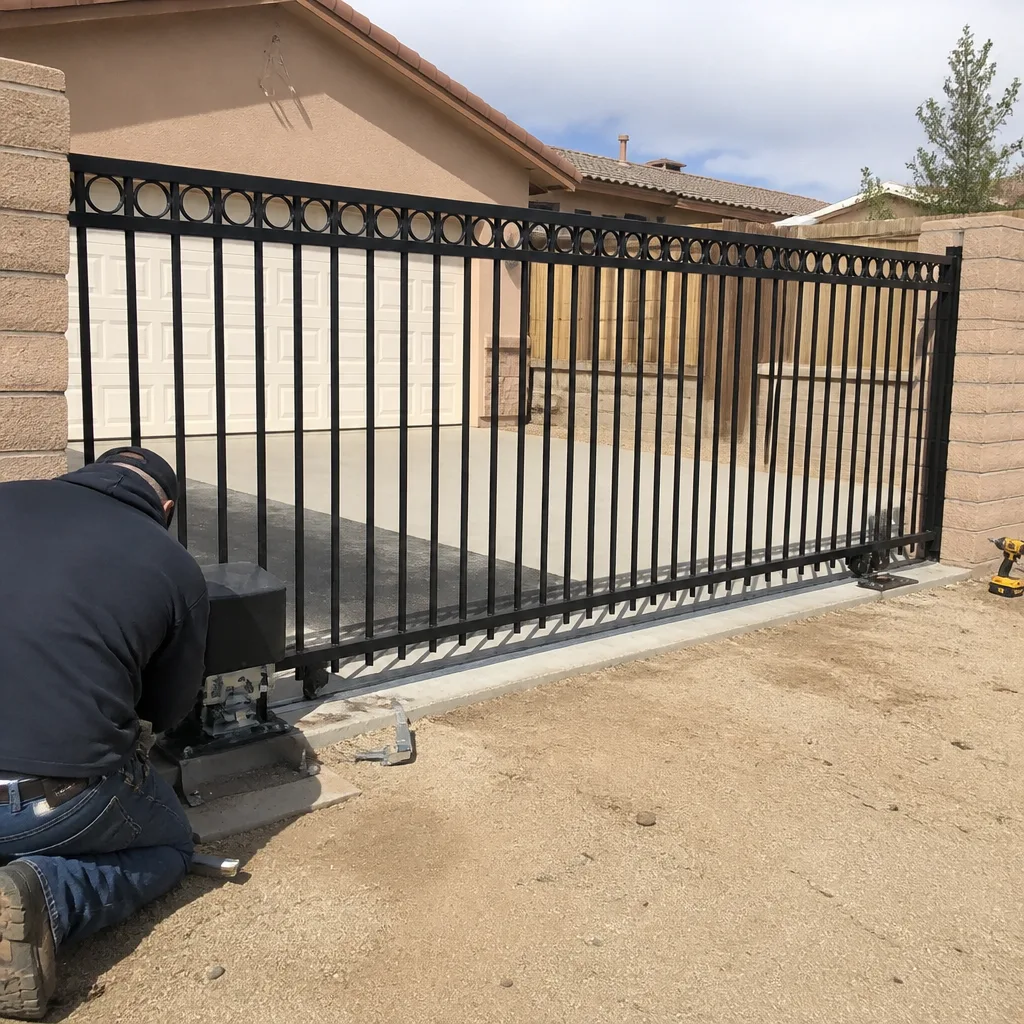
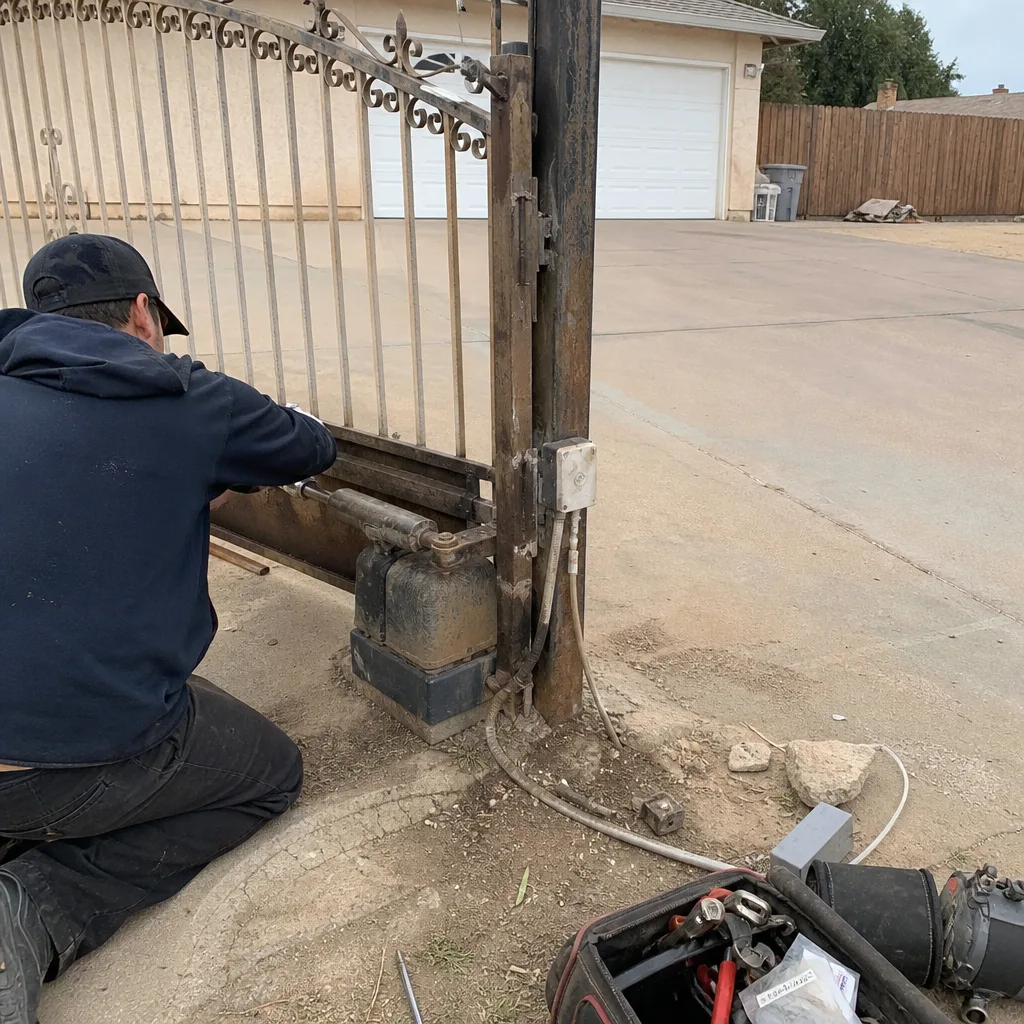
See the difference
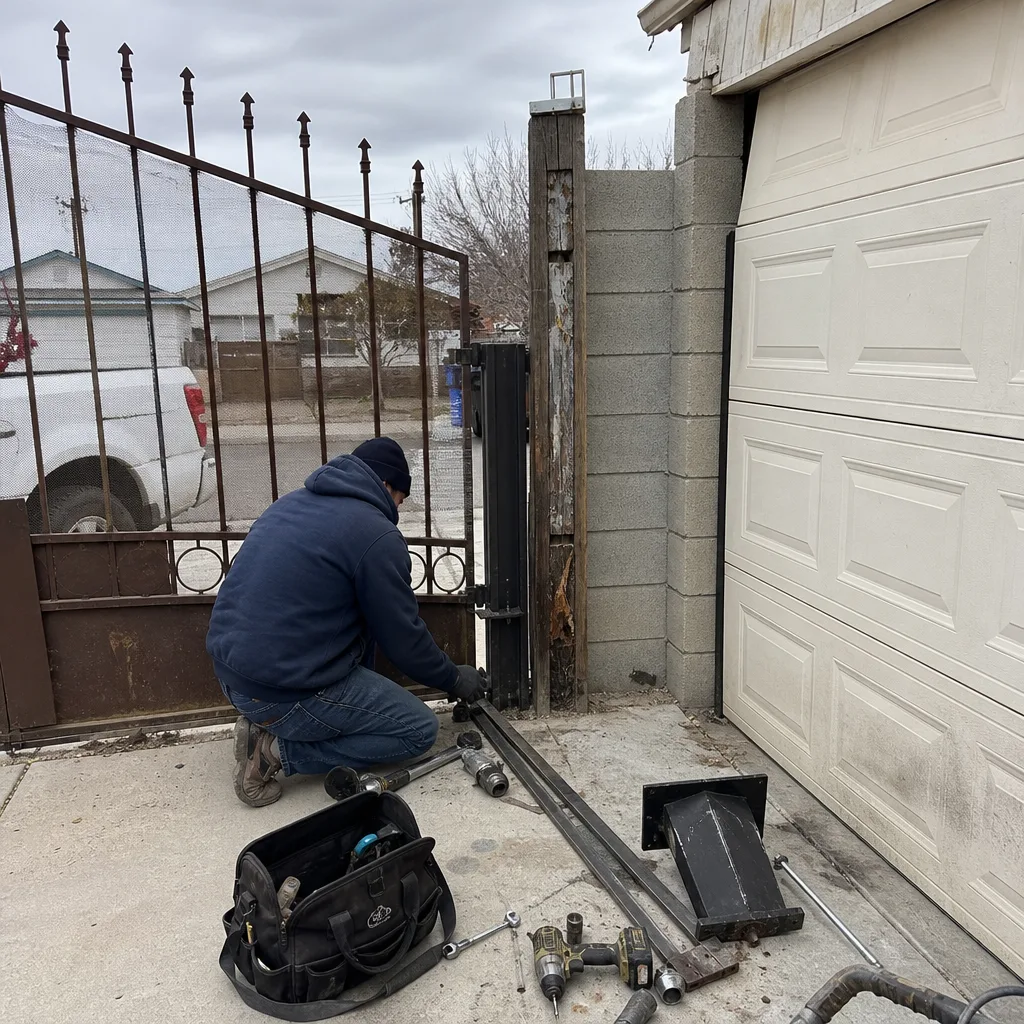 Before
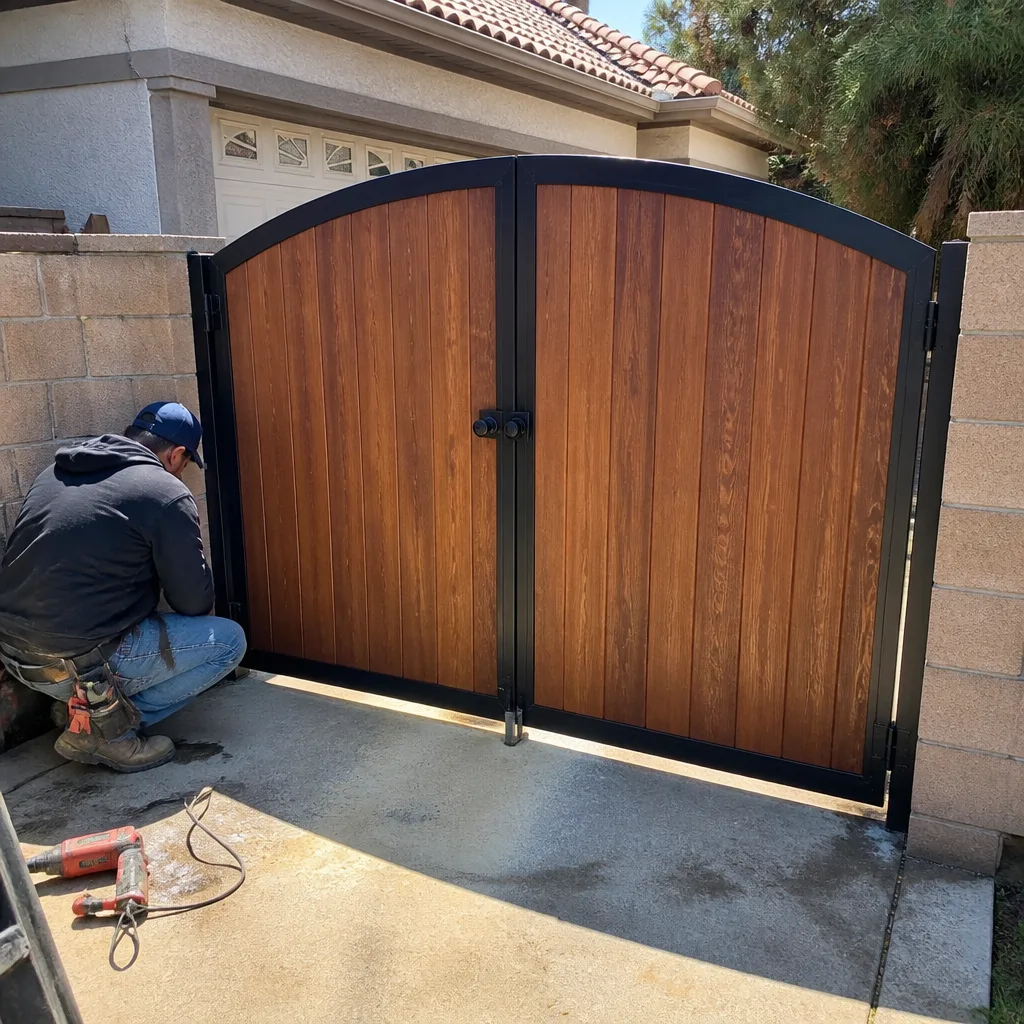 After
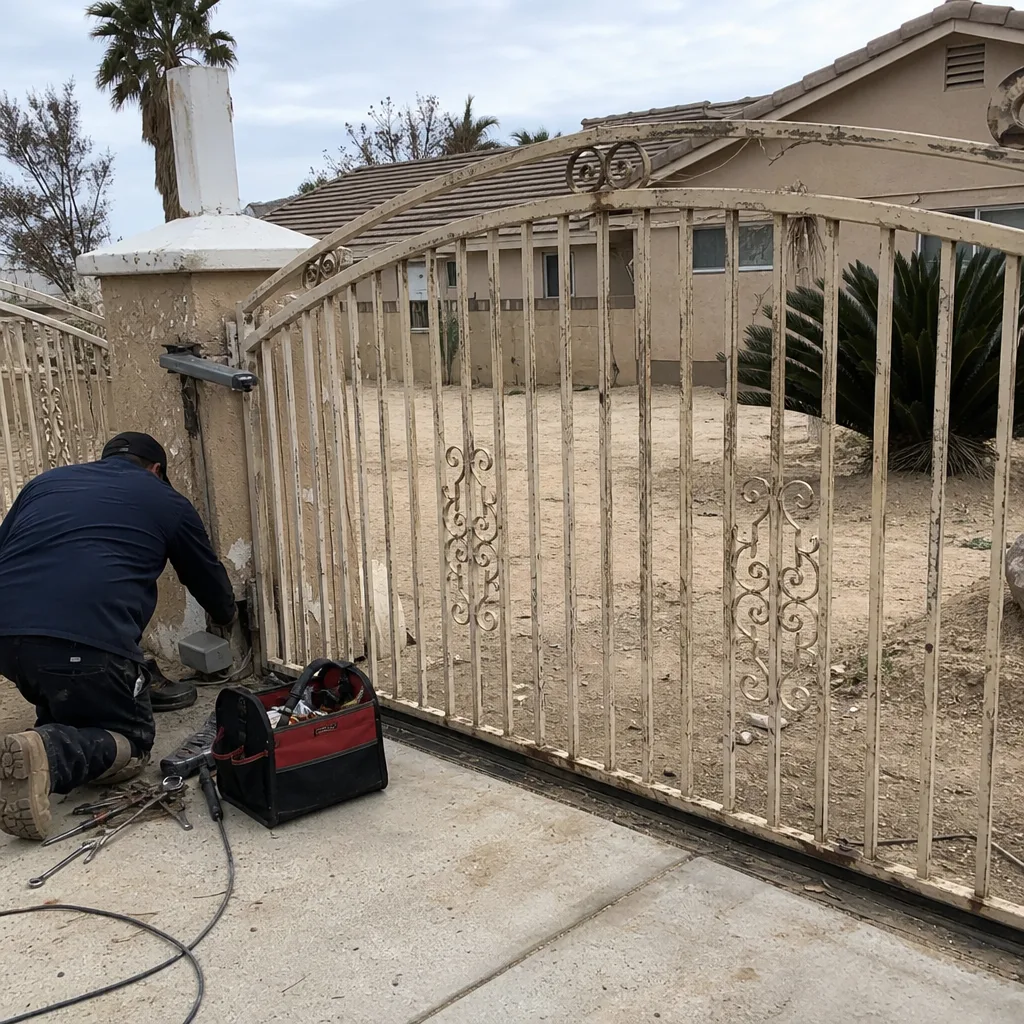 Before
 After
 Before
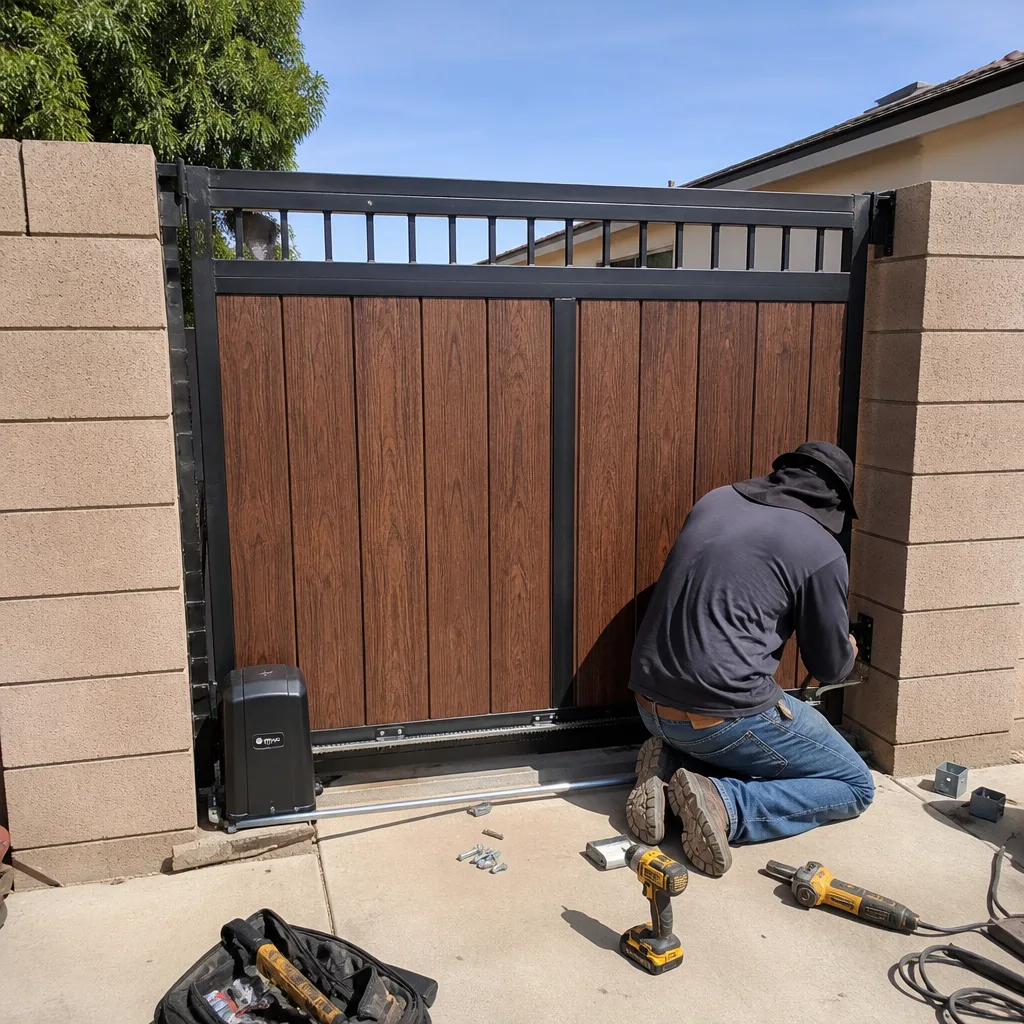 After
When to Call a Professional
Call a professional when the gate struggles to complete a cycle, makes a grinding or chattering sound it did not make before, or trips its breaker repeatedly. Call when you see a post leaning, a weld crack growing, or a safety sensor that won’t clear no matter how many times you wipe the lens. Call when the operator opens but won’t close, or closes but won’t reverse when a vehicle crosses the sensor path. These are symptoms of specific failures, and the longer a failing component stays in service, the more collateral damage it does. For Gate Repair Permits, Codes & Inspections in CA: What You Need to Know, review our compliance overview. Gate Repair Victorville offers free estimates in Victorville, working across nine operator brands including FAAC, BFT, Linear, and Viking. Call (833) 589-9763, describe what the gate is doing, and we’ll tell you over the phone whether it can wait for a scheduled visit or needs same-week attention.
Frequently Asked Questions
Lubricate hinge pins, chains, and rollers every three months. The high-desert environment accelerates lubricant breakdown, so a quarterly schedule prevents the dry-metal contact that destroys hardware. Use dry-film PTFE or high-temp silicone, not white lithium grease.
Thermal expansion changes clearances between gate components as temperatures rise, and heat thins lubricants so they flow away from wear surfaces. A gate that’s quiet in winter and noisy in summer usually has marginal lubrication or slightly loose fasteners that expansion exaggerates.
No, not safely. Operator cabinets contain exposed line voltage, capacitors hold charge after power is disconnected, and some systems have spring or hydraulic stored energy. Homeowner tasks end at sensor cleaning, lubrication, fastener tightening, and battery testing. Anything inside the cabinet needs a trained technician.
Most full maintenance visits in Victorville run between $150 and $350 depending on the gate type, operator brand, and what needs attention. Quarterly DIY maintenance keeps that number on the low end. Call (833) 589-9763 for an exact quote, and the estimate is free.
We service LiftMaster, FAAC, BFT, Linear, Viking, Ghost Controls, DoorKing, Elite, and Mighty Mule. Our technicians are factory-familiar with each brand, and we take a repair-first approach: we fix what’s on your property before recommending replacement.
Most residential operators in Victorville last 7 to 12 years with proper maintenance. Without it, expect 4 to 6 years. The heat speeds capacitor aging, the dust loads gears and sensors, and the temperature swings loosen connections. Maintenance is the difference between those two lifespans.
The Bottom Line
Victorville gates fail differently than gates anywhere else. The caliche soil moves posts. The heat kills batteries and bakes lubricants. The dust plugs sensors and turns grease into grinding compound. A maintenance checklist that doesn’t account for those factors is just a list of tasks. This one is built for the environment your gate actually lives in. Work the quarterly schedule, know your line between DIY and technician work, and when a problem crosses that line, call someone who already knows your system. The alternative is a gate that works right up until it doesn’t, usually at the worst possible moment.
Written by the team at Gate Repair Victorville, serving Victorville since 2013.